bhc grows new-menu sales and reaches 3 million app registrations as Gangnam flagship broadens customer reach
South Korean fried chicken chain bhc has reported growing sales of new menu items and 3 million registrations on its own app. Its flagship near Gangnam Station also targets lunchtime and afternoon diners.
Published
bhc is broadening its customer reach through new menu items, its own ordering app and an experience-led restaurant. According to a Newsway report on 9 November, the South Korean fried chicken chain reached 3 million app registrations alongside rising sales of key menu items launched this year. It has also opened its first flagship restaurant near Gangnam Station in Seoul. For those assessing the franchise, these developments need to be considered separately to understand what they mean for orders and operations at individual outlets.
Assess new-menu sales alongside launch dates and sales channels
Soy Garlic King, which bhc launched in March this year, sold 2 million units in its first six months. Currinkle, introduced in July, sold 1.5 million units within three months. Kwasak Mozza King, launched in September, then recorded 200,000 units sold in three weeks through bhc’s own app and Coupang Eats. Each product has built up sales over a different period following its launch.
These figures indicate consumer responses to individual products, but they are not like-for-like measures. The reporting periods for Soy Garlic King and Currinkle differ, while the Kwasak Mozza King figure explicitly covers two sales channels. Comparing the totals alone therefore does not provide a reliable basis for ranking the products or judging their long-term popularity. The first step is to distinguish initial launch interest from demand accumulated over a longer period.
Newsway reported that bhc introduced a series of follow-up products after Kwasak King helped it return to sales growth last year. Recent launches also include Alssak King and Yangnyeom King. However, no sales figures were provided for those products, so the performance of selected items should not be treated as representative of every new launch.
For franchisees, brand-wide sales and outlet-level sales are also distinct. Cumulative national sales do not imply an equivalent increase in orders in every local market. To understand the impact on an outlet, operators need to examine not only sales of new items but also changes in orders for existing products, total order value and peak ordering times. This is not about dismissing strong sales, but about checking how they translate into day-to-day business performance.
Three million app registrations are not the same as ordering activity
Registrations on bhc’s own app have reached 3 million. Alongside its stream of new product launches, the brand has built a sizeable direct customer channel. The fact that Kwasak Mozza King’s early sales came through both the bhc app and Coupang Eats also underlines the importance of checking which ordering channels a sales figure covers.
However, registered users are not the same as active ordering customers or repeat buyers. The reported figure of 3 million cannot, on its own, be used to calculate order frequency, spending per customer or growth in franchisees’ orders. Keeping registration numbers separate from revenue contribution avoids overstating what the figure shows.
The Kwasak Mozza King sales figure also combines both channels. It would be misleading to describe it as sales generated solely by bhc’s app or to estimate the split between the app and Coupang Eats. Comparing channel performance requires separate sales figures and consistent reporting criteria. Nor does the simultaneous growth in registrations and sales of a particular product establish a causal link between the two.
In practice, it helps to break down an outlet’s orders by channel. The interpretation will differ depending on whether app orders represent additional business or orders that have shifted from another channel. Franchisees considering participation in a promotion can first check which items are included, how long it runs and what preparation their outlet requires, then compare overall ordering patterns before and after the campaign.
Gangnam flagship targets lunchtime and afternoon demand
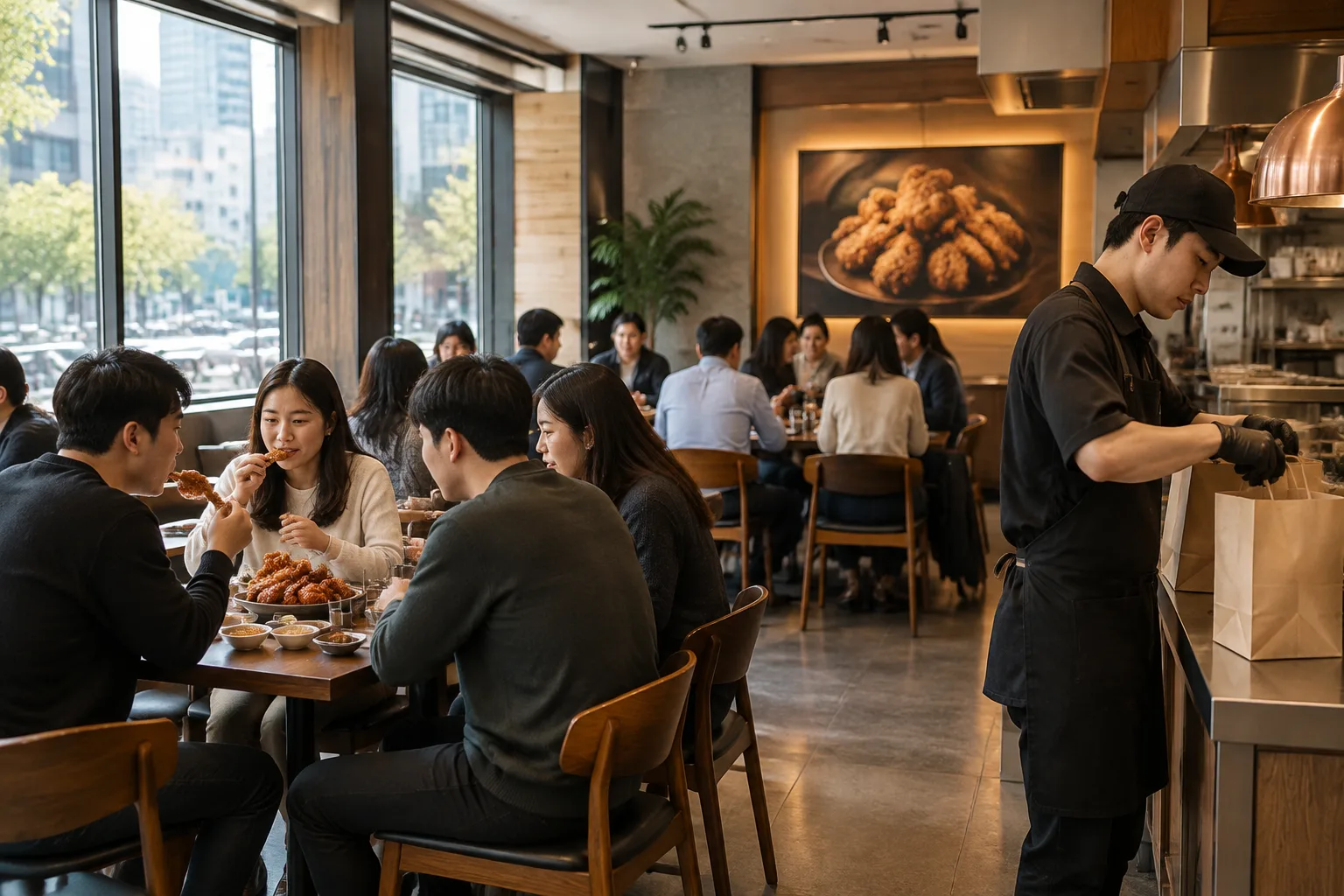
Alongside changes to online ordering, bhc is also developing its physical restaurant offering. According to a Financial News report on 8 November, the brand opened its first flagship restaurant near Gangnam Station in Seoul. The venue features a more upmarket setting and service, as well as a broader menu.
The report said the restaurant was attracting lunchtime and afternoon diners, moving beyond the traditional fried chicken outlet model centred on evening drinks and delivery. While new products broaden menu choice, the flagship can be seen as an attempt to expand both visiting occasions and the dine-in experience.
However, the operating approach of a specialist venue near Gangnam Station should not be taken as a change applying to all franchise outlets. The report concerns the setting, service and menu at the brand’s first flagship. It provides no basis for assuming that the same operating model or refurbishment plans will be introduced across the national franchise network.
For existing outlets, the more useful lesson concerns why customers visit, rather than how the restaurant looks. Operators can assess whether their local market has lunchtime demand, whether they can accommodate afternoon diners and whether they can handle delivery and dine-in orders simultaneously. Before adopting elements of the flagship model, they need to review outlet-specific conditions, including seating, staffing and kitchen workflow.
Translating brand growth indicators into outlet performance
The latest bhc developments show changes across three areas of customer contact: products, ordering channels and physical venues. Key new menu items have accumulated sales, the brand’s app has reached 3 million registrations, and its first flagship is targeting lunchtime and afternoon demand. These three developments cannot, however, be combined into a single measure of improved franchisee profitability.
Further checks are needed to connect brand-level sales figures with individual outlets’ business results. Franchisees can examine the share of total orders accounted for by new products alongside changes in sales of existing items, and review how actual revenue has changed across ordering channels. Those seeking to attract more dine-in customers should also assess orders by time of day and the additional operational demands separately.
Prospective franchisees should likewise avoid basing a decision to open an outlet solely on the popularity of new products or the size of the app’s registered user base. They need to establish the operating conditions relevant to their proposed location and outlet format. Even if the flagship’s customer experience is appealing, they should not assume that the same conditions apply to a standard franchise outlet.
The practical takeaway is straightforward: read new-product sales figures alongside their reporting periods and channels, distinguish app registrations from actual orders, and assess specialist restaurant formats against the conditions at your own outlet.