AoConcept launches whole-house underfloor heating franchise drive, with builder briefing on 9 November
AoConcept announced on 21 October that it is launching a full-scale franchise rollout for its pellet-fired whole-house underfloor heating system. A business briefing on 9 November will target local building contractors and other firms renovating existing and vacant homes in Japan.
Published
AoConcept LLC, based in Chiyoda, Tokyo and headed by Hiroyuki Kubota, announced on 21 October 2026 that it is launching a full-scale business-to-business franchise rollout for its pellet-fired whole-house underfloor heating system, YukadanPellet. The company is recruiting local building contractors and renovation firms across Japan as franchise partners and will hold a business briefing on 9 November. It plans to work with local installers to expand heating retrofits that make use of the underfloor spaces in existing and vacant homes.
Working with local franchisees to retrofit heating in existing homes
Recruitment is aimed at local building contractors, housebuilders, renovation firms and business partners. The company says its goals in promoting the system include bringing vacant homes back into use and tackling cold conditions in existing housing. It is positioning the system as a new renovation option, particularly for contractors and renovation firms operating in cold and moderately cold regions.
According to AoConcept, YukadanPellet uses a patented underfloor heating mechanism to improve thermal conditions inside homes by adapting their existing underfloor spaces. A distinguishing feature is that it is designed for installation in existing homes, rather than being limited to new builds.
For Japan’s franchise sector, this is a recruitment initiative aimed at businesses carrying out local housing renovations. Rather than opening consumer-facing shops, the plan is to work with franchise partners to expand the use of equipment and retrofit services that building contractors can offer to homeowners.
However, the announcement concerns the full-scale launch of the business and the recruitment of franchisees. It gives no figures for franchisee numbers or homes fitted with the system, nor any regional rollout targets. It does not establish that a nationwide installation network or a track record of widespread adoption is already in place.
Combining foundation insulation with warm air supplied beneath the floor
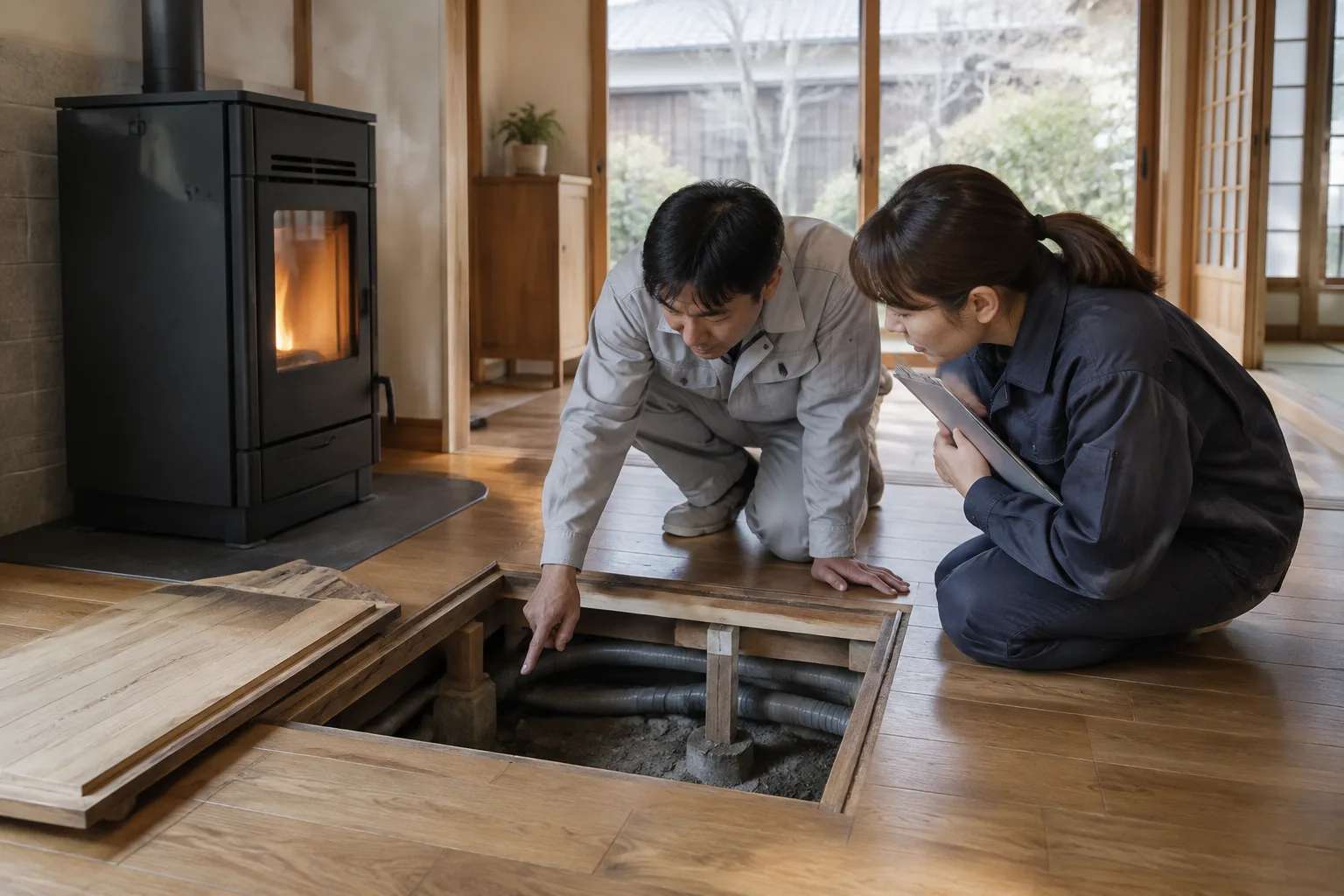
The system centres on a combination of foundation insulation, the dedicated AO-01 pellet stove and circulation fans installed beneath the floor. According to the company, the insulation limits heat transfer through the foundations, while the stove sends warm air into the underfloor space. Underfloor ventilation and circulation fans move the air around to warm the entire space.
Heat from the warmed underfloor space passes through the floor into the rooms above, making the use of existing underfloor spaces central to the proposition. The company says foundation insulation helps retain heat beneath the floor, making indoor thermal conditions easier to maintain.
The AO-01 has an integrated outlet for supplying air beneath the floor. AoConcept says this dedicated design avoids the need for extra installation space for the underfloor air supply, allowing it to be fitted in roughly the same space as a conventional pellet stove. It also sends warm air directly into the room at the same time, supplementing the radiant heat from the stove itself.
A lever on the side of the stove allows the volume of air sent beneath the floor to be adjusted within a set range. The published specifications list a black finish, a fuel hopper capacity of up to 8 kg and automatic ignition. G-PLACE (Okumino Produce) is named as the developer.
Comfort and cost claims need to be assessed for each property
AoConcept says that focusing the work on the underfloor space can provide a comfortable indoor environment while reducing the time and cost burden of installation for homeowners. It also uses the phrase “comfortable barefoot even in midwinter”. This is the company’s description of the product, however; the announcement does not provide measured data demonstrating the same outcome in every home.
The announcement includes no comparative tests conducted under matched conditions, such as floor area, insulation levels and outside temperature. Nor does it give a standard installation price or a specific installation timeframe. Prospective franchisees should distinguish between general comfort claims and the performance they can reasonably expect in the homes they will work on.
There are also differences in the figures and units used for electricity and fuel consumption between the descriptive text and the specification section of the announcement. Before preparing estimates of energy and fuel costs for customers, businesses should confirm the official product specifications and calculation assumptions with the franchisor. The information currently available does not establish that the system will necessarily be cheaper than any particular alternative heating method.
To develop a practical proposal for an existing home, businesses should also establish the building requirements, the scope of work — including foundation insulation and fan installation — and who will be responsible for inspections and maintenance after installation. These matters directly affect what franchisees will need to explain to customers, so understanding on-site delivery is as important as understanding the product’s features.
Franchise terms to clarify at the 9 November briefing
The business briefing is scheduled for Monday 9 November 2026. It is open to local building contractors, housebuilders, renovation firms and business partners across Japan. Those interested should contact the company through the enquiry form on its official website. The announcement does not specify the time, venue or whether online attendance will be possible, so these details will need to be checked when registering.
Details of the franchise agreement, including the initial franchise fee, royalties, training and territorial arrangements, have not been disclosed. Companies considering joining should use the briefing to clarify not only equipment purchasing and installation costs, but also the design and installation support provided by the franchisor, warranty arrangements and the division of maintenance responsibilities.
The initiative is currently at the franchise recruitment stage, with the aim of bringing local contractors and the franchisor together to expand heating retrofits in existing homes. The practical priority is to assess whether the equipment suits the properties a business works on, then confirm the franchise terms and the installation and maintenance arrangements. Attending the briefing with a clear outline of the intended property types and conditions should help prospective partners ask questions that support an informed decision.