Hong Kong Food Franchise Licensing Guide: Check the Menu, Preparation Methods and Licence Scope Before Signing
Brand authorisation is not government approval, and business registration is not a food business licence. Before buying a food franchise, check the menu, preparation processes and sales methods to confirm that the brand’s operating model can legally be implemented at your chosen premises.
Published
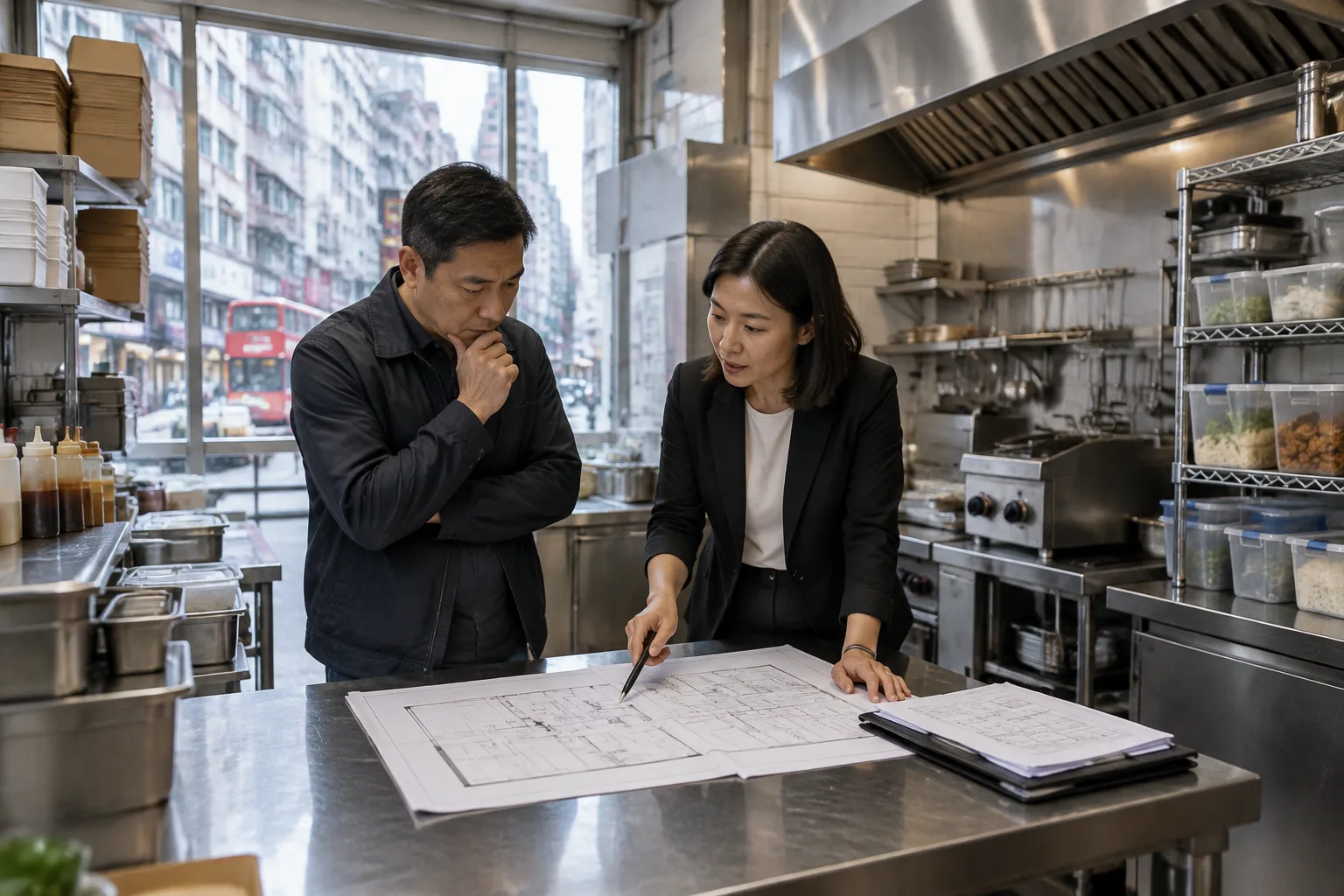
When buying a food franchise, it is not enough to ask, “Does this shop have a licence?” A takeaway outlet, a dine-in restaurant and a central kitchen operating under the same brand may need different approvals. For newcomers to Hong Kong’s franchise market, the real questions are what you intend to sell, where it will be prepared, how it will be supplied, and whether the existing or proposed licences cover that operating model.
1. Distinguish between brand authorisation, business registration and operating licences
A franchise agreement grants the right to use a brand and its operating system. It is not a government-issued permit to trade. If the franchisor says an outlet has been “approved to open”, that does not mean the Food and Environmental Hygiene Department (FEHD), or any other relevant authority, has approved operations at those premises.
Hong Kong has no franchise-specific legislation, nor any generally applicable mandatory franchise disclosure document, franchise registration scheme or statutory franchise code of conduct. The parties’ rights and obligations are governed mainly by general contract law; the Misrepresentation Ordinance may also apply where misrepresentation is involved. The absence of franchise-specific legislation does not exempt a business from food safety or licensing requirements.
Business registration is handled under the Business Registration Ordinance, but a Business Registration Certificate is not a food business licence. Food businesses must also comply with the Public Health and Municipal Services Ordinance and its subsidiary legislation, including the Food Business Regulation, according to their actual activities. Company incorporation documents, franchise certificates and licences held by other branches cannot replace the approvals required for your chosen outlet.
2. Break the menu down into activities that can be checked
Do not simply describe the business to an adviser as a “coffee shop” or “dessert shop”. Obtain the full menu, preparation processes, equipment layout and sales channels from the franchisor, then establish the licence or permit requirements for each activity.
For example, General Restaurant Licences and Light Refreshment Restaurant Licences have different scopes; food preparation under a Light Refreshment Restaurant Licence is restricted. If food is prepared on the premises mainly for takeaway, check whether a Food Factory Licence is required rather than assuming that having no seating means no licence is needed. Selling restricted foods may also require the relevant permits or licence endorsements.
Start with a checklist recording each of the following:
- Food and its source: Will it be delivered by a designated supplier or prepared on the premises from raw ingredients?
- Preparation processes: Will these involve baking, frying, reheating, cooling or handling food intended to be eaten raw?
- Supply methods: Will the food be served for consumption on the premises, sold as takeaway, ordered online or supplied to other branches?
- Special activities: Will alcohol be supplied for consumption on the premises, or will you sell foods that require separate checks?
Have this information checked by an appropriately licensed adviser or the relevant authority. Compliance cannot be established solely from the brand name, the names of dishes or the practices of other branches.
3. Check the actual premises rather than copying a model outlet
Ask the franchisor for verifiable licence details, approved plans, licence conditions and operating procedures. If the premises are already licensed, also check the licensee, address, current validity and any additional restrictions. An existing licence should not be treated as an asset that can simply be borrowed or transferred automatically.
Arrange a site inspection to confirm that the kitchen, food rooms, storage areas and seating layout match the documentation. An extra preparation area, relocated equipment or the use of an unapproved area all warrant further investigation. The franchisor’s approval of a fit-out plan does not mean it meets government requirements.
Where ventilation, drainage, fire safety or building alterations are involved, obtain assessments from the relevant professionals and check the lease and building restrictions. The fact that another branch can use naked flames or install an extraction duct does not establish that your chosen premises can do the same.
The outcome of due diligence should be a written list of gaps: which activities are already covered, which require applications or alterations, which remain unconfirmed, and who will obtain quotations for and pay for each item of remedial work.
4. Address licensing compatibility in the franchise agreement
The agreement should do more than state that “the franchisee is solely responsible for all licences”. Although statutory responsibilities cannot be transferred by contract, the parties can still clearly allocate responsibility for providing information, adapting designs and meeting rectification costs.
First, specify the menus, processes, equipment specifications and plans the franchisor must provide, together with its commitments regarding their accuracy. Next, set out whether the franchisor must help revise the design if its standard outlet format is incompatible with local approval requirements, whether the franchisee may suspend the affected activities, and how related fees or performance requirements will be adjusted.
Menu changes after opening deserve particular attention. Before requiring new products, new processes or expanded supply methods, the franchisor should allow the franchisee to check whether additional approvals, works or equipment are needed. The agreement can set out an assessment procedure, cost allocation and interim arrangements pending approval, so that a “standardised menu” does not become pressure to risk breaching the rules.
Practical takeaway: Before making any payment, cross-check the menu, preparation processes, premises plans and licence conditions item by item. Record any unconfirmed activities as outstanding issues and assign responsibility for resolving them. Do not treat “other branches have always done it this way” as proof that an operation is lawful.