
Franchising in Colombia: how to negotiate your territory
Before buying a franchise, establish what protection your territory offers and how online sales, deliveries and new outlets will be allocated.
Published
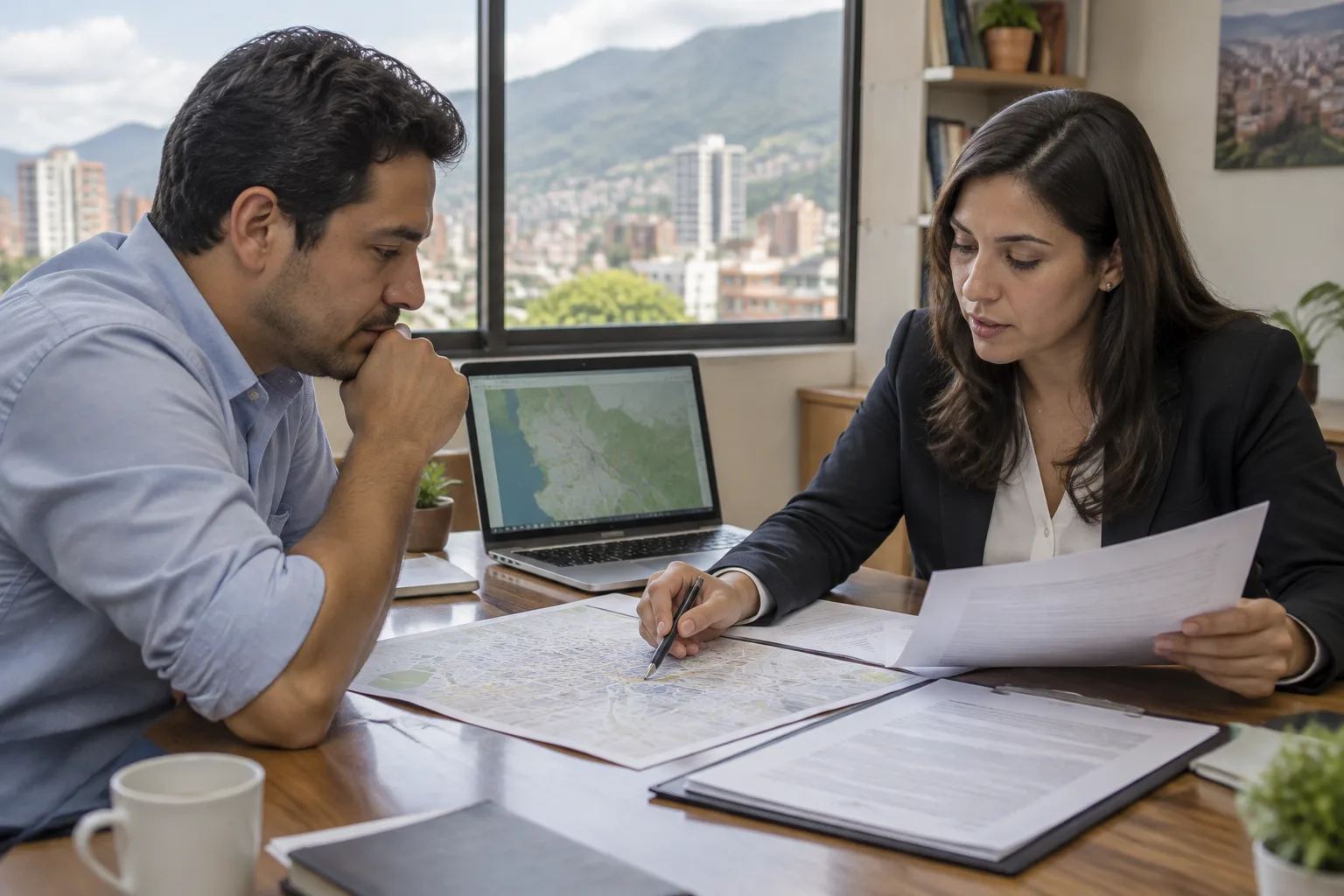
An attractive location does not guarantee a protected trading area. Before joining a franchise network in Colombia, clarify who will be allowed to sell near your premises, fulfil deliveries or attract customers online. This guide explains how to review and negotiate your territory before paying the initial franchise fee, turning a promise of exclusivity into obligations you can verify.
1. Distinguish between location, territory and exclusivity
These are different concepts. The approved location is the premises from which you may operate. The allocated territory is the geographical area designated for your business activities. Territorial exclusivity is a contractual obligation restricting certain actions by the franchisor within that area. Having the first two does not mean you have the third.
An offer stating ‘exclusive area in Bogotá’ is not enough. It must specify the boundaries and explain what is prohibited: opening company-owned outlets, granting new franchises or selling through other formats. It must also identify any exceptions.
Request a schedule to the agreement containing a map and a matching written description. Boundaries can be defined by roads, coordinates or clearly marked polygons. Avoid vague references such as ‘catchment area’ without a method for defining its limits.
Ask explicitly:
- Does the protection cover only outlets of the same format, or also kiosks and temporary sites?
- Are there any approved outlets that have not yet opened?
- Are shopping centres, airports or corporate customers excluded from the territory’s protection?
- Can the franchisor reduce the territory, and under what conditions?
Do not interpret silence as exclusivity. If territorial protection is crucial to your investment decision, it must be included in the agreement and its schedules.
2. Understand what Colombian law protects
In Colombia, a franchise agreement is an atypical contract: there is no specific law comprehensively governing this relationship. The Ministry of Justice explains this in its guidance on these agreements. The general rules of the Commercial Code and Civil Code apply, including those relating to obligations, contracts and good faith.
Nor is there a specific general requirement to provide a franchise disclosure document with legally standardised content and a statutory disclosure deadline. You should therefore request written information in advance about territories, planned openings and sales channels reserved by the franchisor. The absence of a mandatory disclosure document does not remove the duties of good faith during negotiations.
Law 1429 of 2010 concerns business formalisation and job creation; it is not a franchise law. Likewise, a business’s commercial registration is not a special registration of the franchise agreement certifying its territorial exclusivity.
Andean Community Decision 486 governs aspects of industrial property, including trade marks and their licensing. However, a trade mark licence does not, by itself, guarantee commercial protection against other outlets in the network.
Competition rules must also be observed, including Law 155 of 1959, Decree 2153 of 1992 and Law 1340 of 2009. A lawyer should assess territorial restrictions in light of their scope and context: exclusivity is not always unlawful, and a restriction is not necessarily valid simply because it appears in a signed agreement.
3. Include online sales and deliveries
The biggest gap often arises when an agreement protects against new openings but permits online sales without explaining how orders will be fulfilled. A central online shop may receive orders from customers right next to your outlet.
Propose a table within the agreement setting out four points for each channel: who sells, who delivers, who issues the invoice and who receives the revenue. Include the brand’s website, delivery apps, corporate sales and telephone orders.
For example, if an order comes from an address within your territory, the agreement should clarify whether it is allocated to your outlet, whether another outlet may fulfil it for capacity reasons, or whether compensation is payable. None of these arrangements should be taken for granted.
Also establish who bears the cost of discounts, commissions, returns and delivery. If the franchisor promises compensation for sales made through another channel, agree on the calculation method, supporting records and settlement frequency. Request sufficient reports to verify the calculation, while complying with personal data protection rules.
4. Link protection to verifiable conditions
Some brands make exclusivity conditional on sales targets or the opening of additional outlets. Before accepting, assess whether those targets are achievable and who can change them.
Ask for the agreement to specify the performance measure, information source, assessment period and consequences of failing to meet the requirements. Negotiate a period in which to remedy any shortfall before losing protection, as well as provisions addressing temporary closures or delays attributable to the franchisor.
For potential breaches by the franchisor, establish a complaints procedure, response deadlines and dispute resolution mechanisms. Seek independent advice on the specific remedies available; do not assume compensation will be automatic.
Practical takeaway: before paying, obtain three documents that are consistent with one another: a territory map, a sales-channel allocation table and an exclusivity clause. If they do not establish who may sell, where and under what conditions, there is still more to negotiate.
Sources
- ¿Cómo se elabora un contrato de franquicia?
- [PDF] Resumen Ejecutivo El contrato de franquicia en Colombia opera en ...
- Cómo adquirir una franquicia en Colombia en 2025
- Las claves para comprar una franquicia de forma segura
- Franquicia Colombia: concepto, tipos y ejemplos
- 1
- Cinco claves para comprar una franquicia de forma segura
- ¿Cómo es el proceso para iniciar una franquicia en Colombia?