Infopan aims to double its franchise territories in 2027
The bread-bag advertising franchise added five territories in Argentina in 2026 and aims to double both the number of territories sold and the volume of bags distributed.
Published
Infopan, the franchise that sells advertising on paper bags distributed through bakeries, aims to double both its territories sold and its bags distributed in 2027 compared with the previous year. The business, which added five territories in Argentina during 2026, combines local advertising sales, distribution through shops and donations of baked goods to community meal centres.
A new phase for the Argentine operation
Aline Aparecida Vonsovicz took over the Infopan master franchise for Argentina in January 2026. According to a report published by Nueva CABA on 13 November, drawing on an interview she gave to iProfesional, her involvement with the brand began as a franchisee in May 2019.
At that time, she acquired the territories of Las Heras, Pico Truncado and Caleta Olivia, in the province of Santa Cruz. Born in Curitiba, Brazil, and based in Argentina since 2016, Vonsovicz has thus moved from managing her own territories to leading the network’s national development.
Her master franchise covers Argentina only. Infopan also operates in Colombia, Mexico, Paraguay, Chile, Uruguay and Ecuador, according to information from its official website cited in the report.
For 2027, Vonsovicz aims to double both territories sold and bags distributed compared with the previous year. She also set a target of distributing 36 million paper bags to replace plastic ones. These are expansion targets, not results already achieved.
How bakery advertising works
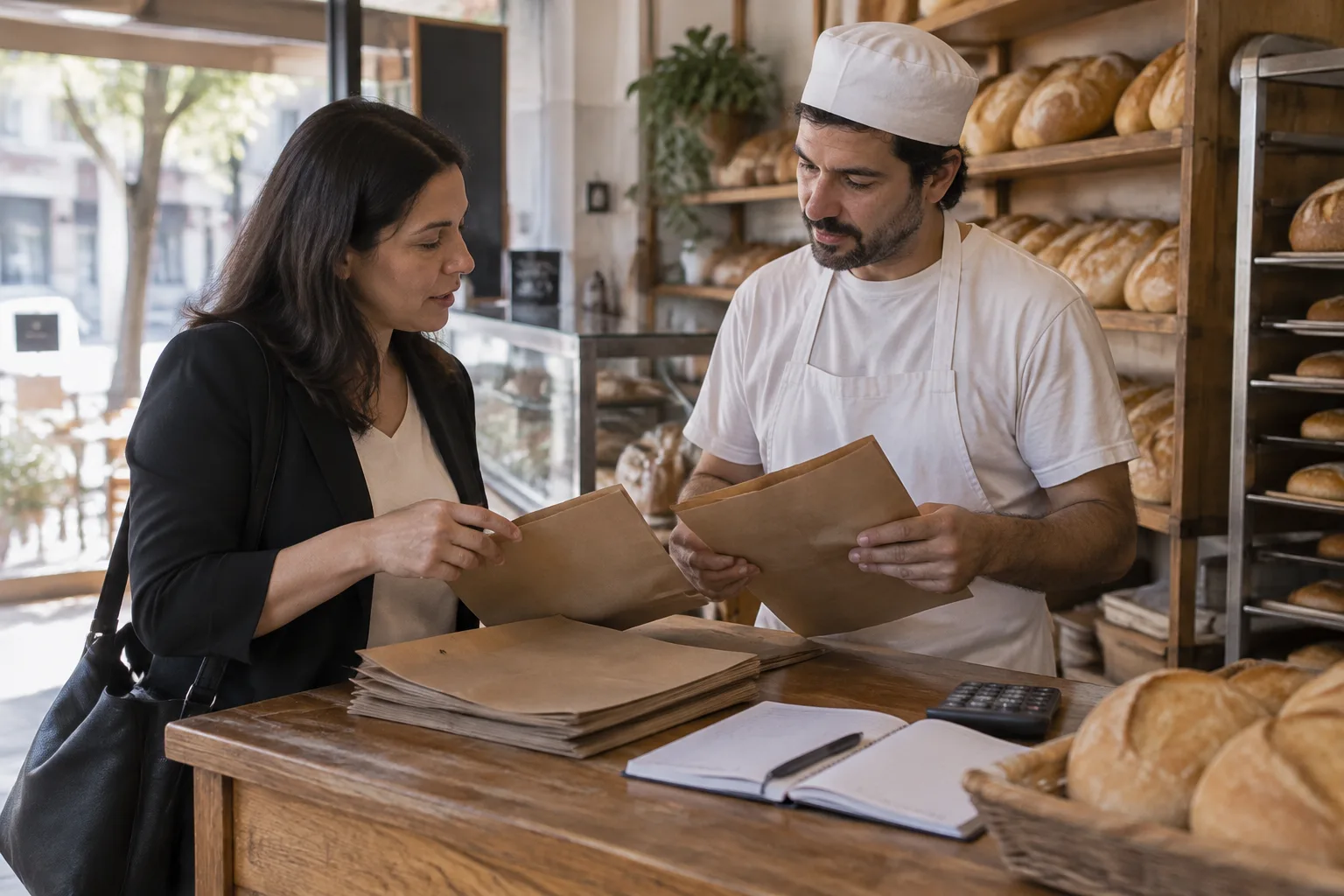
Franchisees recruit advertisers within their territory, sell space on the paper bags and organise distribution through bakeries. Each campaign runs for four months and includes between 20 and 30 advertisers, with exclusivity by business category.
Advertising starts at ARS 45,000 per month and is booked for four-month periods. The bags connect local businesses, service providers and small and medium-sized enterprises with consumers shopping at participating bakeries.
Each territory covers up to 100,000 residents. Before a territory is approved, the available bakeries and the commercial potential of prospective advertisers are assessed. Defining a territory therefore also involves reviewing local sales opportunities.
The work continues once the advertising space has been sold: franchisees must renew campaigns, organise distribution and coordinate donations of baked goods to a local community meal centre. This combination sets the proposition apart within the franchise sector, bringing together commercial activity and coordination with local shops and community organisations.
Franchise fees, production and recurring costs
According to the figures provided by Vonsovicz, the initial franchise fee is US$3,000 plus VAT for one territory, US$4,000 plus VAT for two and US$5,000 plus VAT for three. The fee includes training and a sales materials kit.
The franchise fee is not the full investment required. Bag production is an additional cost, with a minimum order of 20,000 units. At the quoted price of ARS 110 per bag, that order comes to ARS 2.2 million plus VAT.
The model envisages funding production through the first instalments collected from advertisers. Prospective franchisees should therefore examine the timing of receipts and payments, as well as the initial franchise fee.
Vonsovicz reported an 8% royalty and a 2% advertising contribution. She also estimated average monthly turnover of around ARS 2 million per territory and profits of approximately ARS 1 million, with an investment payback period of eight to fifteen months. These figures are estimates supplied by the brand’s operator and should not be interpreted as guaranteed returns.
No premises required, but daily sales work is essential
The business does not require franchisees to rent premises or hire staff, nor does it require previous experience in sales or advertising. However, its operation depends on attracting advertisers and maintaining relationships with bakeries.
Vonsovicz estimated that developing one or two territories as a supplementary business would require four to six hours a day. She also suggested running two or three territories simultaneously for those with more time available.
Practical takeaway: before signing up for a territory, check its potential advertiser base, the full cost of the first campaign and the payment collection schedule. Not needing premises does not remove the need for working capital or a commitment to sales.