Supply Planning Before Franchising a Business in Venezuela
Define suppliers, purchasing rules and contingency plans before franchising. A guide to maintaining quality and continuity in Venezuela.
Published
A business may run well because its owner sources supplies, negotiates personally and resolves every shortage. But that individual ability is not the same as a supply system that others can replicate. Before franchising in Venezuela, you need to turn purchasing into a verifiable system: what each outlet must buy, from whom, on what terms and what to do when supplies fail. This protects the customer experience and trust across your franchise network.
1. Identify which purchases truly define the concept
Not all supplies require the same level of control. A signature recipe may depend on a specific ingredient; cleaning products, by contrast, could be bought locally if they meet a technical specification. Requiring a single supplier for everything creates dependency without necessarily improving quality.
Divide purchases into three groups:
- Essential to the brand’s identity: products, components or materials whose substitution changes the value proposition.
- Subject to specifications: items that can come from different suppliers, provided they meet verifiable requirements.
- Freely sourced: items that do not affect the business’s distinctive attributes, although they must meet applicable legal and safety requirements.
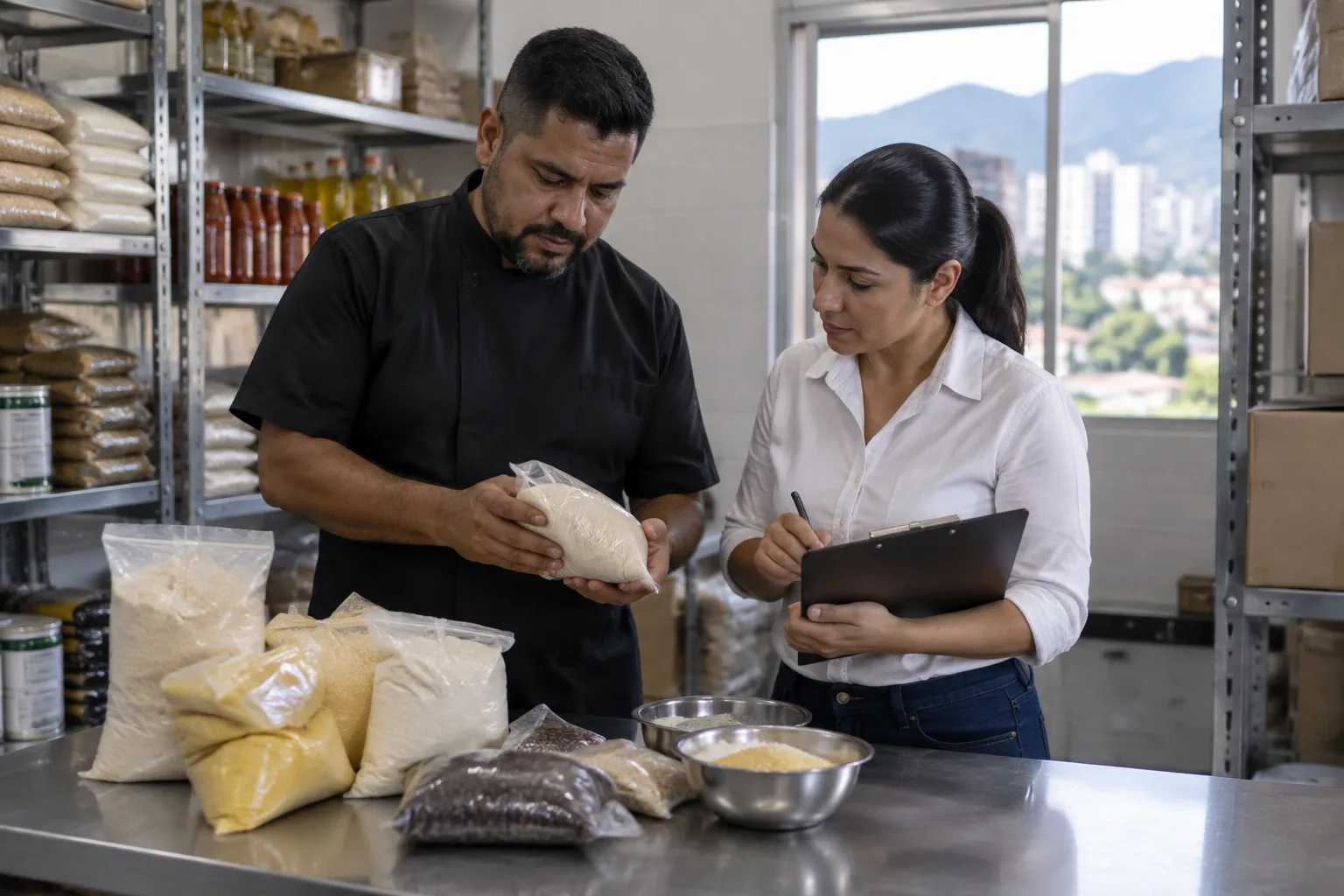
For each essential item, record its specification, storage conditions, shelf life where relevant, replenishment lead time and available alternative. Avoid descriptions such as ‘superior quality’: use characteristics that can be checked when goods arrive.
The result should be a supply matrix, not simply a list of contacts. That matrix shows which dependencies you are passing on to a future franchisee.
2. Check that suppliers can support expansion
A supplier capable of serving your current outlet may not be able to supply several locations. Before committing to new openings, request information on delivery capacity, geographical coverage, minimum orders, transport and returns procedures.
Check promises against evidence: fulfilled orders, incomplete deliveries, quality issues and responses to exceptional orders. If a product requires specific hygiene conditions or specialised transport, also review the relevant documentation.
Calculate the total cost of getting supplies to the outlet, not just the catalogue price. Include freight, storage, foreseeable losses, insurance where applicable and costs associated with minimum orders. A volume discount may offer little benefit if it means holding stock that expires before it can be sold.
Where imported components are involved, identify who is responsible for importing them, handling the paperwork, dealing with delays and replacing defective items. Do not promise continuous availability if it depends on conditions you have not yet verified.
Before approving a supplier, document who authorises product changes, how price changes are communicated and what happens to orders already accepted.
3. Put purchasing rules into the contract with appropriate legal advice
Venezuela does not have a comprehensive franchise-specific law or a general pre-contractual disclosure regime equivalent to those in countries that require a standardised legal disclosure document. This does not mean the parties can agree to any terms they wish: the Civil Code, the Commercial Code and other relevant legislation apply.
For mandatory purchases and supplier restrictions, the Decree with the Rank, Value and Force of an Anti-Monopoly Law is particularly relevant. The Guidelines for the Evaluation of Franchise Agreements, issued by Procompetencia in 2000, also form part of the regulatory background. They should not be presented as comprehensive franchise legislation or as automatic authorisation for contractual restrictions; seek advice on their scope and current application.
The contract should specify:
- Which purchases are mandatory and their technical or commercial justification.
- How alternative suppliers are approved and who assesses samples.
- Who invoices, transports and takes responsibility for defects or incomplete deliveries.
- How changes to terms are communicated and outstanding orders are handled.
- Which procedure applies when the designated supplier cannot supply the goods.
If the franchisor sells supplies directly or receives benefits from suppliers, disclose that relationship and its financial implications. Concealing it makes it harder for prospective franchisees to assess the business’s costs accurately.
4. Design a contingency plan that preserves quality
Resolving a shortage should not depend on ad hoc authorisation. Define in advance which products can be substituted, which require testing and which must be temporarily withdrawn from sale if an essential component is unavailable.
For example, a coffee shop could use pre-approved alternative packaging, but should not change the ingredient that determines the flavour of its main product without an assessment. Contingency planning must protect both continuity and brand identity.
Assign responsibilities, establish notification channels and set criteria for returning to normal supplies. Record each substitution, including the reason, batch details where relevant and the outlets affected. This makes it easier to investigate complaints and correct failures.
5. Test the system before offering new franchise outlets
Simulate orders for the planned locations and compare actual lead times, costs and terms. Check whether minimum orders are compatible with expected demand and whether there is sufficient financial capacity to maintain stock levels.
Practical conclusion: before franchising, put together a supply matrix, documented supplier terms and a contingency procedure. If supplies still depend on personal favours secured by the owner, resolve that dependency before passing it on to a franchisee.
Sources
- Elementos esenciales para la constitución y protección de ...
- Cómo crear y gestionar una franquicia rentable en ...
- Franquicias en Venezuela: Cómo Crear o Comprar una ...
- Ricardo Antequera: La columna vertebral de las franquicias está directamente relacionada con la propiedad intelectual - Universidad Monteávila
- Franquicias en Venezuela: Guía Legal y Claves | PDF
- Marco jurídico de las franquicias en Venezuela - Blog Banesco
- Los 10 mejores Abogados de Franquicias en Venezuela (2025)
- ithy.com › article › comercial-expansion-venezuela-wgyikaaxExpansión Comercial en Venezuela: Agencias, Sucursales y...