Kyochon Chicken opens in Wuxi, entering Jiangsu province, as second Shenzhen outlet prepares to launch
Kyochon Chicken has opened an outlet in Wuxi, Jiangsu province, and is preparing to launch a second in Shenzhen. Its menu combines signature chicken flavours with options tailored to local preferences as the brand expands its presence in China.
Published
Kyochon Chicken has expanded its presence in China with a new outlet in Wuxi, Jiangsu province. According to a Money Today report dated 2 October 2026, Kyochon F&B recently opened the outlet in a shopping centre near Lake Tai. It is also preparing to open a second Shenzhen outlet, following the first, which launched last year. For franchise businesses considering overseas expansion, the announcement offers a case study in location selection, menu development and how a brand presents itself in-store.
Entry into Jiangsu through Wuxi, with another Shenzhen outlet planned
Kyochon F&B’s newly announced outlet is in Wuxi, Jiangsu province, in a shopping centre near Lake Tai. The company plans to use the opening as a springboard to accelerate its expansion in China. The key development is that, alongside its existing presence in Shenzhen, it now has an outlet serving customers in Jiangsu.
It is important to distinguish between outlets that have opened and those still preparing to launch. The Wuxi outlet has recently opened, whereas the second Shenzhen outlet was described as awaiting its opening. The two should therefore not both be counted as newly operating outlets, nor should the second Shenzhen location be assumed to be trading already.
The report said Kyochon opened its first Shenzhen outlet last year. Taken together, the Wuxi opening and the planned second Shenzhen outlet show both entry into a new region and further expansion within a city where the brand already operates. These facts alone, however, do not establish the total number of outlets in China or the pace of future expansion.
The report did not give the Wuxi outlet’s exact opening date, floor area or seating capacity. Nor did it confirm a specific opening date for the second Shenzhen outlet. The announcement indicates the direction of expansion, but should not be treated as confirmation of outlet sizes or a detailed rollout schedule.
The company’s plans to develop its Chinese business are also separate from the performance of individual outlets. Although the new opening is confirmed, the report provides no basis for assessing sales, visitor numbers or the investment payback period at Wuxi. An opening announcement is not, in itself, evidence of profitability.
Soy, Red and Honey chicken joined by glazed chicken bites and skewers
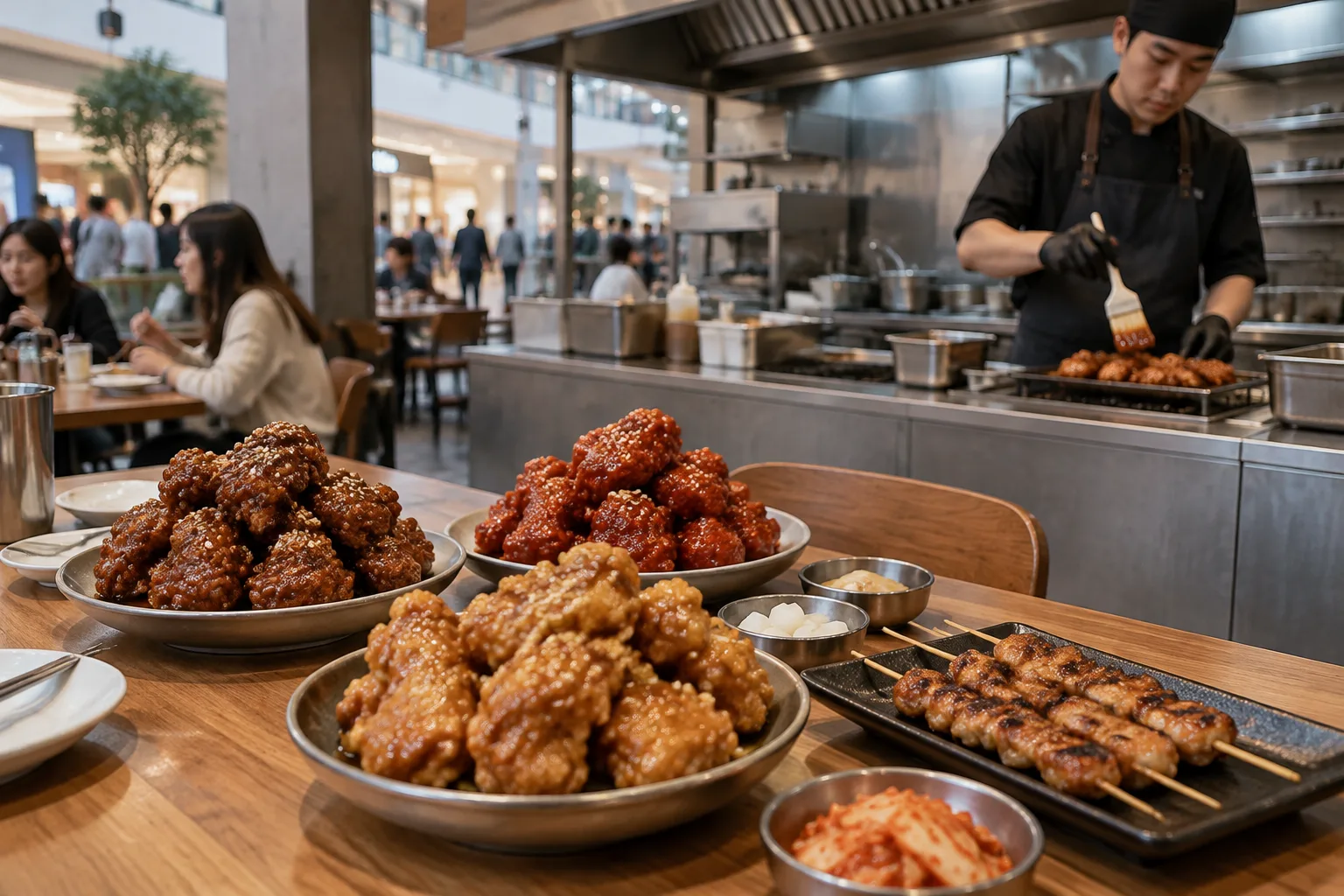
The Wuxi outlet offers Kyochon Chicken’s signature Soy, Red and Honey ranges. It also serves dakgangjeong — crispy glazed chicken bites — and chicken skewers, which the company says reflect local consumer preferences. The menu retains the brand’s signature products while adding options intended to appeal to local tastes.
This is different from replacing the existing menu wholesale. Kyochon’s three signature ranges remain central to the Wuxi offering, with glazed chicken bites and skewers presented as additional choices. Franchise businesses exploring overseas expansion can use this as an example of how core products and locally tailored options can sit alongside one another.
However, a menu designed to reflect local preferences is not the same as one with proven local popularity. The report explains the rationale behind the selection, but gives no order volumes or customer feedback for individual dishes. It does not establish that glazed chicken bites or skewers have become leading sellers at Wuxi.
Information on pricing and sales formats is also limited. The available details do not allow a comparison between menu prices in South Korea and Wuxi, or establish whether identically named dishes are sold in the same format. For franchise operators, the useful point is the balance between brand identity and local adaptation, rather than the performance of any particular item.
The operational impact of a wider menu also requires further investigation. Cooking procedures, ingredient management and order handling are all relevant when comparing overseas outlets, but the report provides no such details for Wuxi. Menu names alone are not enough to assess operational efficiency or the additional workload involved.
Brand history and cooking methods displayed on the walls
The Wuxi outlet uses its interior, as well as its menu, to introduce the brand. Wall displays trace Kyochon’s growth from a small shop of roughly 33 square metres in 1991 to a network of around 1,400 outlets worldwide. They also explain its distinctive method of brushing sauce onto the chicken.
The figure of around 1,400 refers to the brand’s worldwide network, not its outlet count in China. It appears in the report as part of the story of Kyochon’s growth. Its inclusion alongside news of the Wuxi opening should not be read as suggesting that the company operates that many outlets in China.
A notable feature of the interior is the combination of the brand’s origins and its preparation methods. Rather than limiting the information customers encounter to a menu, the outlet uses its walls to explain Kyochon’s history and cooking techniques. This is a specific example of how the brand is presented at Wuxi.
The report does not, however, assess whether these displays influence purchasing decisions or repeat visits. They are better understood as elements used to introduce the brand in an overseas outlet, rather than as a proven means of increasing sales.
Franchise businesses reviewing this example could use it to consider which parts of their own history and actual cooking practices they can communicate to customers. While it is possible to identify what Kyochon has displayed at Wuxi, there is no guarantee that the same approach would produce the same results for another brand.
Separate confirmed openings from assessments of performance
The confirmed developments are clear. Kyochon has opened an outlet in a shopping centre near Lake Tai in Wuxi, combining signature products with menu options intended to reflect local preferences. Its wall displays introduce the brand’s origins and cooking methods, while a second outlet is being prepared in Shenzhen.
The report does not establish the level of investment, the identity of the outlet operator, the contractual structure or the logistics arrangements. Without details of how the Wuxi outlet is run, readers should be cautious about assuming that it follows the same franchise model as outlets in South Korea, or treating it as a direct overseas expansion opportunity for existing franchisees.
A more detailed assessment will require actual trading results and operational information. The second Shenzhen outlet’s opening will also need to be confirmed before it can be considered operational rather than planned. For now, the appropriate focus is on three verifiable developments: geographical expansion, menu composition and the in-store presentation of the brand.
In practical terms, this case can inform a review of overseas outlet locations, menus and brand communication. Before making an investment or franchise decision, however, prospective investors should separately verify the contractual terms and outlet-level profit and loss figures.