Questions to Ask Existing Franchisees in Japan and How to Approach the Meetings
Meeting existing franchisees lets you compare the franchisor’s explanations with day-to-day reality. Learn whom to approach, how to frame your questions and how to use the answers when deciding whether to join.
Published
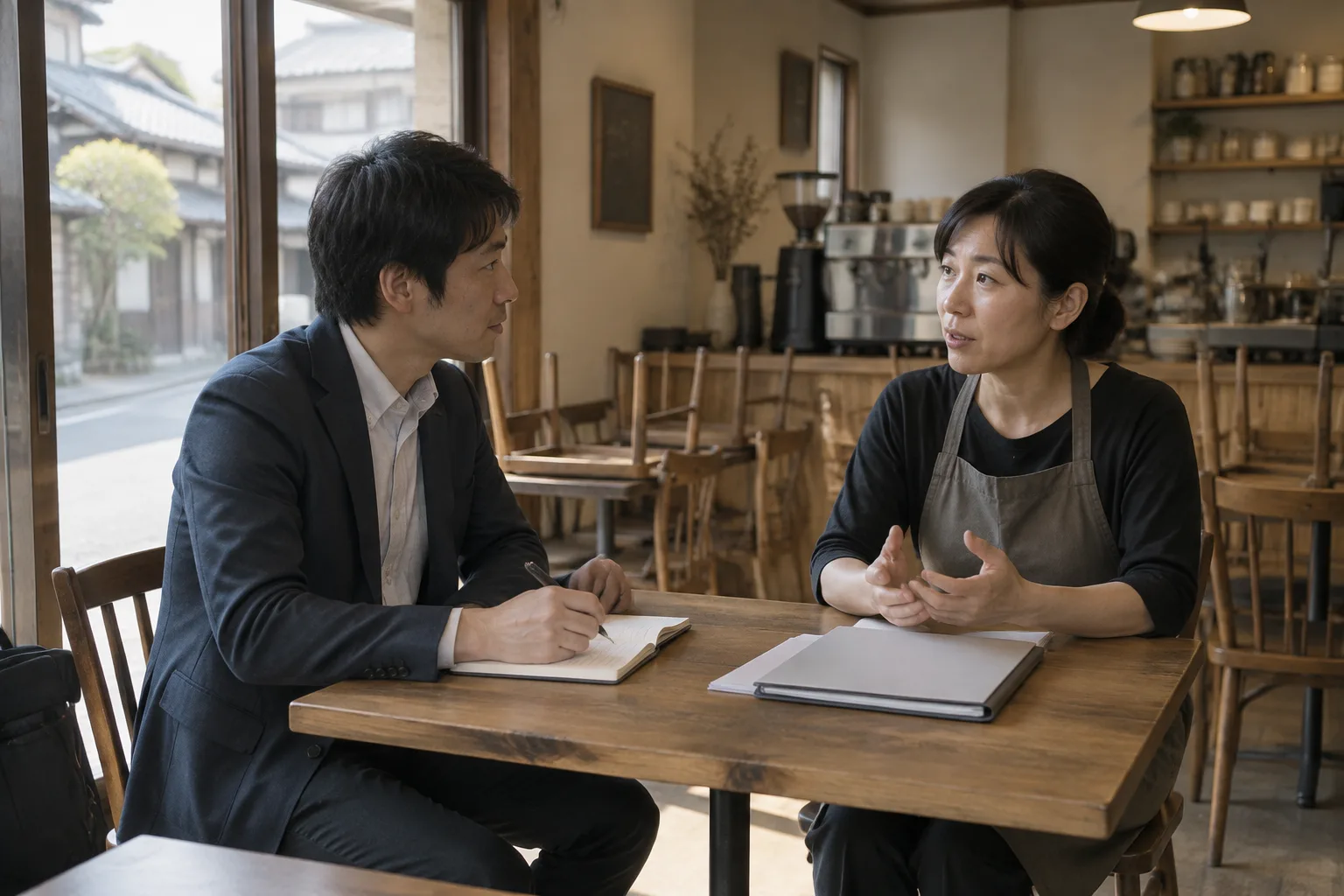
When considering a franchise in Japan, speaking to existing franchisees can give you insights into everyday operations that presentations and store visits alone cannot provide. However, it is risky to base your decision on one person’s success story or complaints. To establish whether you could realistically run the business as part of the franchise network, take a purposeful approach, from choosing whom to speak to through to checking what you have learnt afterwards.
What to establish when meeting existing franchisees
The aim is not to rate the brand’s reputation. It is to understand how the operating methods described by the franchisor work in practice, and exactly what work and responsibilities you would be taking on.
Japan’s Small and Medium Enterprise Agency also highlights the importance of speaking to existing franchisees and professional advisers before joining. Franchisees are independent business operators, not employees of the franchisor. Even if another owner feels they can ‘leave it to head office’, that does not mean the franchisor will take responsibility for your obligations.
Start by turning the franchisor’s explanations into brief questions you can check. For example, if you have been told that ‘no previous experience is needed’, ask: ‘Once the business is open, which decisions does the owner have to make?’ or ‘Which tasks were difficult to learn?’ Actual actions and events provide a better basis for a decision than general expressions of satisfaction.
Before each meeting, make separate notes on these three areas:
- What the franchisor has promised in writing
- What its representative has explained verbally
- What you are simply expecting, but have not yet confirmed
Making this distinction helps you avoid mistaking expectations for contractual rights.
Choose franchisees with different operating circumstances in mind
Franchisees introduced by the franchisor can be valuable sources of information. However, their location or operating arrangements may not resemble those you are planning. Ask the franchisor: ‘Why have you suggested this outlet?’ and ‘Can I also speak to franchisees operating in circumstances similar to mine?’
Useful points of comparison include how long the business has been open, its location and size, how often the owner works on site, and whether they operate one outlet or several. Even within the same brand, the daily demands of a family-run business differ from those of an outlet run by an employed manager. If possible, meet several franchisees in different circumstances and distinguish recurring themes from issues specific to individual outlets.
Owners whose backgrounds resemble yours can be particularly helpful. If you are joining without previous experience, ask what they wish they had understood when they first opened. This can reveal areas you need to prepare for. Bear in mind, though, that a long-established franchisee may not be operating under the same terms as those currently offered to new recruits.
If you contact outlets independently rather than through an introduction, avoid turning up unannounced and launching into questions. Explain that you are considering joining the franchise, what you would like to discuss and how much time you are asking for. Agree a time that will not disrupt their business. Their willingness to help is a courtesy, not something you are entitled to.
Obtain consent in advance before recording the conversation or sharing answers, and do not request customer information, employees’ personal information or confidential documents. A refusal to take part does not, in itself, mean there is a problem with the franchisor or the outlet.
Ask about specific experiences, not general impressions
Use a core set of questions for every franchisee. This gives you a consistent basis for comparison and helps prevent you from placing too much weight on the views of someone you find particularly easy to talk to.
‘What do you personally do as the owner in a typical week?’
Ask about recruitment, staff attendance management, bookkeeping, ordering and dealings with the local community, as well as customer service. Distinguish between tasks the owner handles personally and those delegated to employees or external professionals. Even if the answer is ‘I leave it to the manager’, ask who steps in when someone is absent or an unexpected problem arises. This will give you a clearer picture of the involvement required.
‘What differed most from your expectations before joining?’
If someone says something was difficult, ask them to explain what happened, when it happened and the circumstances. It is important to distinguish temporary challenges just after joining from problems that continue today. Ask for equally specific examples of what went well.
‘When you raised a problem with the franchisor, how was it handled?’
For a recent example, ask whom they contacted, how the response was handled, who made the decisions and where they could turn if the issue remained unresolved. An individual representative’s helpfulness is not the same as an organisation’s procedures. It is also useful to ask whether franchisees have opportunities to put forward their views and what responses they have received.
‘What would you advise someone considering this franchise now to check first?’
Leaving this question until the end can bring out issues your prepared questions have missed. However, distinguish between rumours about other outlets and events the person has experienced directly. There is no need to speculate about the financial health of their business or press them to show you private accounts.
Alongside each answer, record the outlet’s circumstances and when the event took place. This helps prevent you from turning ‘that happened at this outlet’ into ‘that will happen at every outlet’.
Check the answers against the franchisor’s documents before deciding
After the meetings, create a table for each issue, with columns for ‘the franchisor’s explanation’, ‘the franchisee’s experience’ and ‘unanswered questions’. Conflicting answers do not necessarily mean either party is wrong. Differences may reflect when the contract was signed, the outlet’s circumstances, the department involved or changes in operating practices.
When putting follow-up questions to the franchisor, do not identify the speaker without their consent. Instead, ask: ‘I understand this practice exists; how would it work under the contract I am being offered?’ What matters is not how another outlet was treated in the past, but which terms will apply to you. Request written answers and, where a point needs to become a contractual commitment, discuss having it included in the agreement or accompanying contractual documents.
In Japan, Article 11 of the Act on the Promotion of Small and Medium-sized Retail Business requires franchisors whose operations qualify as a ‘specified chain business’ under the Act to provide written information and explain it before a contract is signed. This mainly concerns retail and food-service franchises, but coverage depends on statutory criteria, including arrangements for supplying goods. Not every franchise agreement falls within its scope. Speaking to existing franchisees is not a substitute for the franchisor’s statutory disclosure and explanation obligations.
The Japan Fair Trade Commission’s guidelines on franchise systems under the Antimonopoly Act also set out matters that should be disclosed and conduct that may raise concerns under the Act. These guidelines apply to franchises generally, not just retail and food service. Franchisees are independent businesses, and their dealings with franchisors are subject to the Antimonopoly Act. However, dissatisfaction alone does not establish an abuse of a superior bargaining position or another infringement; the specific circumstances must be examined.
If your meetings reveal significant discrepancies in the explanations you have received, do not sign while those questions remain unresolved. Organise your records and the draft agreement, and consult a lawyer or another appropriate professional adviser.
Practical takeaway: Ask franchisees in different circumstances the same questions and record their specific experiences. Then confirm the terms that will apply to you against the franchisor’s written documents. Following this sequence will help you make a decision based on more than a favourable impression or a sense of unease.