Ghaziabad: ATM franchise operator accused of embezzling ₹7.728 million
Police have registered a case following a court order over alleged embezzlement of ₹7.728 million linked to cash replenishment at 31 ATMs. The investigation is ongoing.
Published
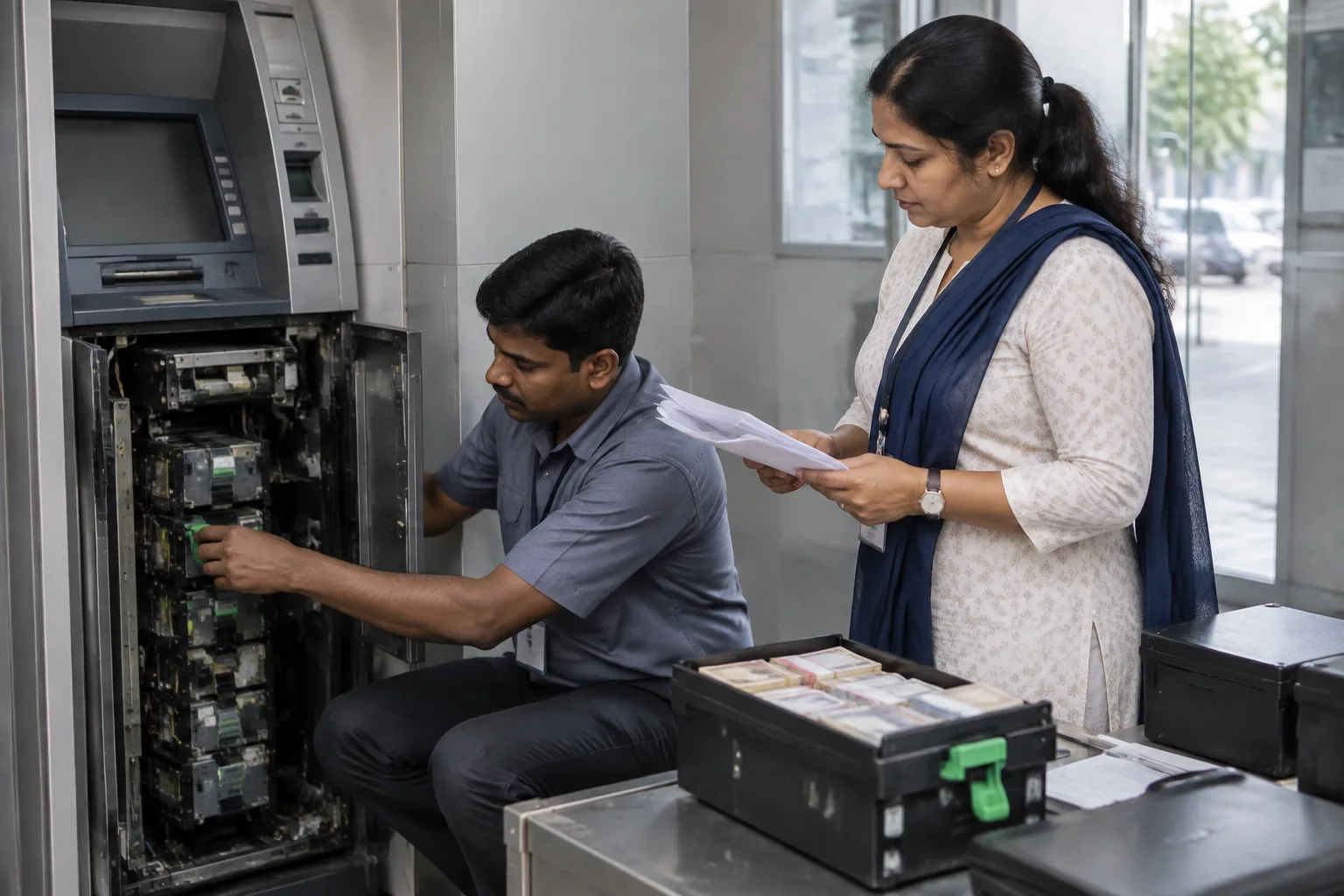
A dispute over a franchise agreement for ATM cash replenishment and maintenance in Ghaziabad, India, has led to a police investigation. Following a complaint by an assistant manager at Hitachi Payment Services Private Limited, police have registered a case against a franchise operator over the alleged embezzlement of ₹7.728 million. The case was registered on a court’s order, and the allegations remain under investigation.
Responsibility for 31 ATMs
According to a Live Hindustan report published on 24 October 2026, Ghanshyam, an assistant manager at the company, submitted a complaint to the court. The complaint stated that the company replenishes cash and maintains ATMs for various banks, entering into agreements with franchise operators in different cities to carry out this work.
According to the complaint, responsibility in Ghaziabad was assigned to Gaurav Verma, a resident of Seva Nagar and the franchise operator of GD Services. Under the arrangement, he was responsible for cash replenishment and maintenance at 31 ATMs across the city. Funds for this work were transferred to his account at an ICICI Bank branch in Ghaziabad.
The case does not concern the sale of a new franchise or the raising of initial investment. The complaint concerns cash transferred under an operating arrangement and the accounting for its use. The dispute therefore centres on financial responsibilities entrusted to an operator within a franchise relationship.
Funds transferred and the alleged shortfall
According to the company’s complaint, ₹576 million (57.60 crore) was transferred to the franchise operator’s account between 23 September 2025 and 18 January 2026 to replenish the 31 ATMs. It alleges that ₹7.728 million (77.28 lakh) of this sum was neither accounted for nor loaded into the ATMs.
The complainant says the company repeatedly contacted the operator to request an account of the funds but received no satisfactory response. The complaint also alleges abusive behaviour towards company employees and misappropriation of the money rather than its return. These are all allegations made by the complainant and should not be read as findings of the investigation.
It is important to distinguish between the two amounts. ₹576 million is the total reportedly transferred for cash replenishment during the period, while the alleged failure to account for funds and the embezzlement accusation concern ₹7.728 million. It would be incorrect to describe the entire transferred amount as an alleged loss. Similarly, the reference to 31 ATMs describes the scope of the operator’s responsibilities; it does not establish that irregularities occurred at every machine.
Police investigation following a court order
According to the complaint, the company approached the police several times from 8 July onwards, but no case was registered. The complainant then approached the court. Following the court’s order, a case was registered against the franchise operator at Nandgram police station.
Nandgram Assistant Commissioner of Police Ziauddin Ahmed confirmed that the case had been registered. He said the matter was being investigated and that further action would depend on the facts. At this stage, the confirmed procedural developments reported are the registration of the case and the ongoing investigation.
The registration of a police case is not a finding of guilt. The complaint’s claims about the use of the money, the accounting for it and the alleged embezzlement remain subject to investigation. Nor should this development be interpreted as a new regulatory change or a conclusion applicable to all ATM franchise arrangements.
Practical lessons for the franchise community
The case raises a clear question for the franchise community to review: where a partner is entrusted with handling cash, how are transfers reconciled against records of its use? This is a due diligence question, not an established finding that controls were deficient in this particular case.
Businesses and operators considering such agreements should clearly set out responsibilities, reporting deadlines, record retention requirements and procedures for resolving discrepancies in writing. During operations, both parties would benefit from keeping documentary records of funds received, their use for the agreed purpose and any amounts still awaiting reconciliation.
Practical takeaway: When assessing a franchise involving cash management, examine the regular reconciliation process as well as the agreement itself. Any further conclusions in the Ghaziabad case will depend on the facts established by the police investigation.