Coop wins franchise award for store improvements
Coop has received two awards recognising improvements including store refurbishments, self-service checkouts and hybrid smart stores.
Published
The Coop Group has won Franchise Chain of the Year at Trade magazine’s Retailer of the Year awards, as well as the Nébih-KMÉ Special Award for Sustainability. According to a report published by Hungarian news website 24.hu on 22 October, the awards recognise environmentally conscious and energy-efficient store improvements, technological upgrades and expanded services. For those interested in Hungary’s franchise market, the story highlights the importance of modernising existing stores.
Two awards focused on operational improvements
Trade magazine held its Retailer of the Year competition for the twelfth time in 2026. The competition gave both single-site retailers and multi-store chains an opportunity to showcase their achievements. Within the main retail chain category, entrants could submit individual applications presenting their product and service ranges, alongside the professional and commercial achievements that help distinguish them in the market.
Coop took first place in the Franchise Chain of the Year category within the retail chain awards. The report highlights ongoing, environmentally conscious and energy-efficient store improvements aimed at greater sustainability, alongside technological modernisation and service development. The award therefore recognises work across several aspects of the network’s operations, rather than the opening of a single new shop.
Coop also received the Nébih-KMÉ Special Award for Sustainability. This award recognised retailers that place particular emphasis on environmental responsibility in their operations and demonstrate good practice in sustainable food retailing. The two awards thus acknowledge the same broad direction from different perspectives: modernising stores and the services they provide.
Nearly a hundred stores refurbished each year
Coop’s geographical coverage illustrates the scale of its presence in Hungary: according to the published figures, it operates 2,076 stores across 1,422 towns and villages. With almost 16,000 employees, it is one of the country’s largest employers in smaller communities. For the franchise sector, this means its investment programme is not simply a matter of upgrading retail sites in major cities; the network also plays a significant role in smaller towns and villages.
The chain has 341 members. Together, they spend several billion Hungarian forints each year refurbishing nearly a hundred stores. This recurring refurbishment programme is one of the tangible foundations of the award-winning improvements: modernisation extends to existing shops, rather than simply creating new retail outlets.
When interpreting these figures, it is important to distinguish between membership numbers, store numbers and annual refurbishments. The 341 members do not represent 341 shops, and nearly a hundred refurbished outlets do not mean the same number of new openings. The focus here is on improving stores already in operation, with a proportion of the wider network being upgraded each year.
Self-service checkouts and hybrid operations
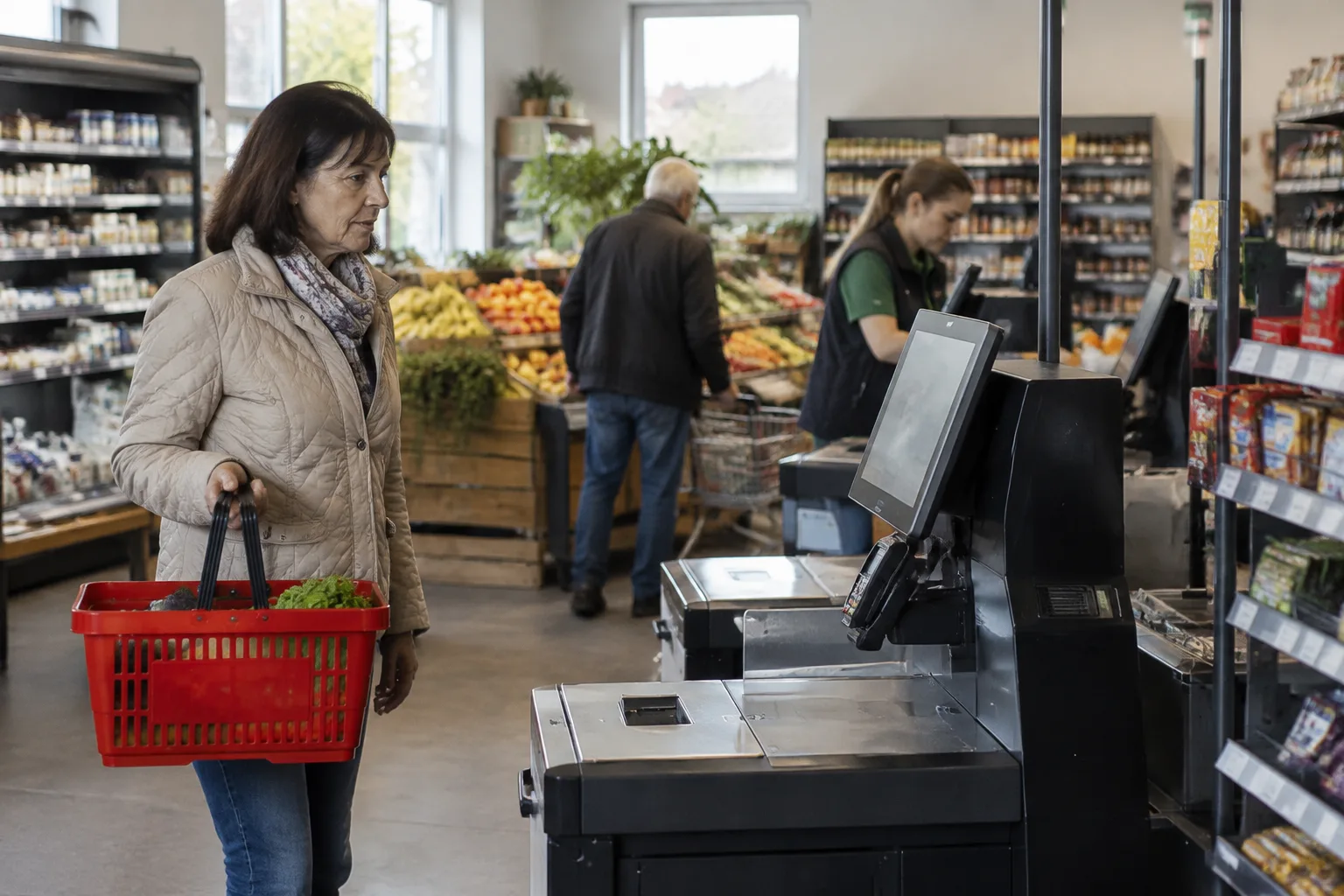
One concrete result of digitalisation is the installation of 44 self-service checkouts across twelve Coop franchise stores. This is a clearly defined initiative: the published figure relates to twelve shops, not the entire network of more than two thousand outlets. Self-service payment is therefore one of the specific elements highlighted in the modernisation programme.
The hybrid smart store represents a different operational approach. In 2025, a shop opened in Szeged as part of Coop Szeged Zrt.’s network, described in the report as Hungary’s first automated hybrid smart store. It operates with staff during normal opening hours and welcomes customers without on-site staff at other times, using a remote monitoring system.
A key feature of the model is that the store’s full range of 4,000 product lines remains available throughout unstaffed periods. This is not simply an additional vending service with a limited selection, but one shop operating in two different modes. Staffed service and remote monitoring provide access at different times of day.
A second smart store with more services
The hybrid format expanded with another outlet in early September 2026. During the twentieth-anniversary Coop Rally, the company opened its second hybrid smart store. The new outlet offers a larger sales area, a wider range and an expanded package of services, with round-the-clock access for customers.
This development helps explain the awards because it demonstrates not only technological modernisation but also improved customer access. Self-service checkouts change how customers pay, while hybrid operation changes when they can access the shop’s full range. The two solutions address different operational questions, even though both are linked to digitalisation.
The practical lesson for the franchise sector is to assess store development separately in terms of refurbishment, payment options and opening-hours models. When planning to modernise an existing shop, the first step should be to clarify which customer need and operational requirement the investment is intended to address.