Franchising a Hong Kong Business: Setting Closure Rules for Typhoons and Emergencies
Typhoons, flooding or building closures can force franchise outlets to shut at short notice. Franchisors should agree decision-making, notification, fee and reopening procedures in advance, so franchisees are not caught between safety and contractual obligations.
Published
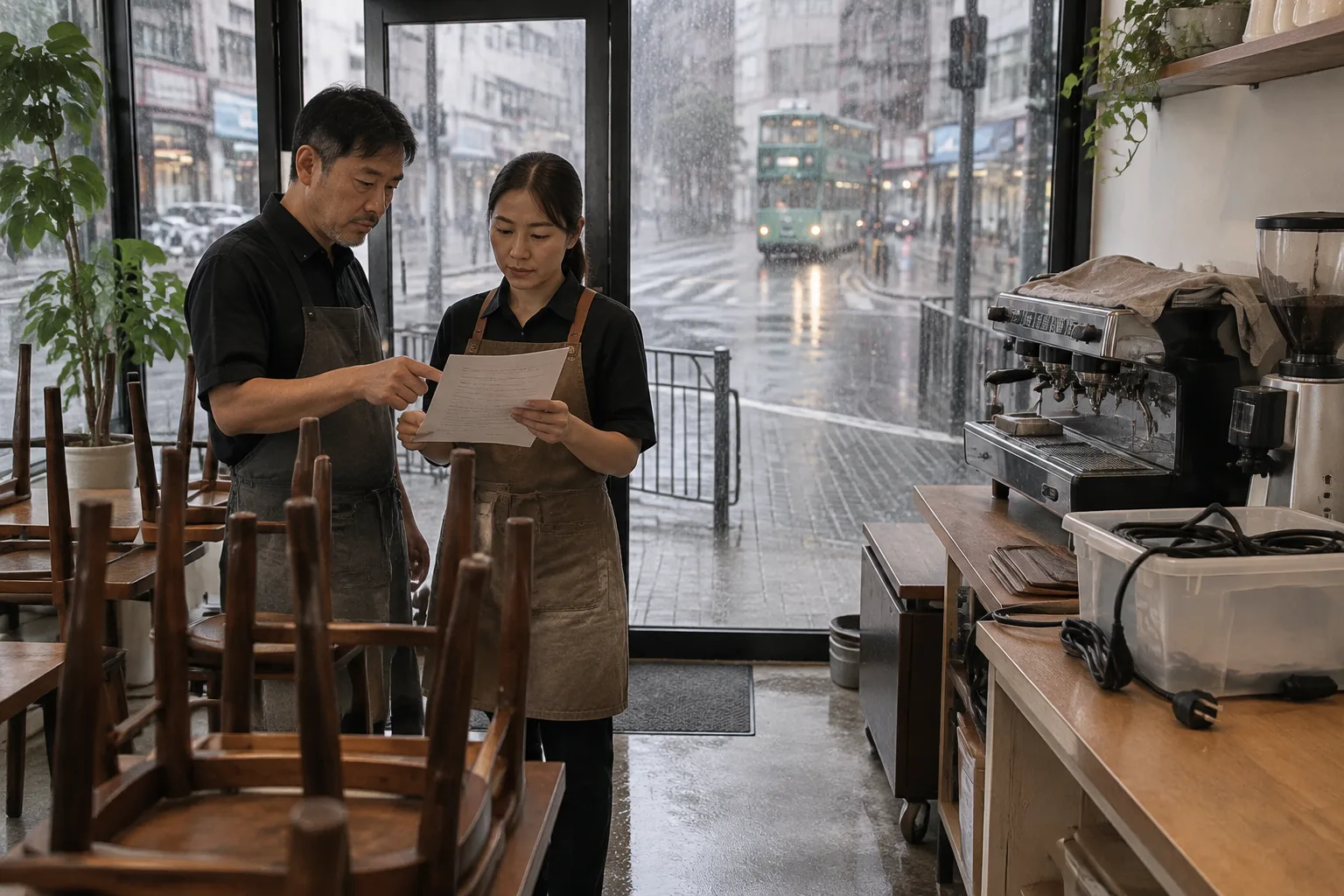
Turning an existing Hong Kong business into a franchise network involves more than replicating procedures for normal trading days. If a typhoon strikes, flooding occurs or access to a building is suddenly prohibited, can franchise outlets decide to close on their own? Which fees remain payable during the closure? Before recruiting franchisees, the franchisor should set out temporary closure and reopening arrangements in the franchise agreement and operations manual, so safety decisions do not depend on last-minute negotiations.
1. Distinguish safety-related closures from relief from contractual obligations
Hong Kong has no dedicated franchise legislation, nor any generally applicable statutory franchise disclosure or filing regime, or mandatory franchise code. The filing and eligibility requirements under mainland China’s Regulations on the Administration of Commercial Franchises should not be treated as requirements for local franchising in Hong Kong.
Franchise relationships in Hong Kong are governed primarily by contract and general law. Where employee safety is concerned, applicable legislation, including the Occupational Safety and Health Ordinance, must also be considered. A franchise agreement cannot replace an employer’s statutory duties, nor should brand trading-hour requirements be used to insist that an outlet continues operating in unsafe conditions.
Temporarily closing does not automatically release a business from all its contractual obligations. Hong Kong common law has no general force majeure rule that automatically excuses businesses from liability when a typhoon occurs; protection depends primarily on the wording of the contract. The doctrine of frustration has a narrow scope, and a brief closure should not be assumed to qualify. Ask a Hong Kong solicitor to review the triggering events, causation, notification and loss-mitigation requirements.
2. Create a decision table that outlets can use immediately
The franchisor should distinguish between three situations: closure required by a competent authority; premises that cannot, objectively, be used safely; and premises that can still trade but are experiencing reduced customer traffic. The third is usually a commercial judgement and should not necessarily receive exactly the same treatment as a mandatory closure.
The operations manual can use a decision table to set out:
- Immediate action: Where people are in danger, the outlet manager may stop admitting customers and arrange for people to reach safety before notifying the franchisor, without first obtaining an exemption from trading requirements.
- Assessment: In severe weather, assess the outlet’s flood risk, transport conditions, property management instructions and employee safety, rather than relying solely on weather warning signals.
- Information to report: Record when the closure began, the extent of the disruption, conditions on site and measures taken. Do not require employees to put themselves at risk to take photographs as evidence.
- Backup contacts: List primary and alternative contacts, and explain how records should be submitted retrospectively if telephone or internet services are disrupted.
For example, if a shopping centre closes its entrances because of flooding, the franchisee should retain the management office’s notice and update the outlet’s trading status, rather than attempt to force access to meet trading-hour requirements. The franchisor should also adjust order-taking settings on its central platform at the same time, so a closed outlet does not continue receiving orders.
3. Specify each fee payable during a closure
Simply stating that ‘performance is suspended during force majeure’ invites disputes: does this suspend only the obligation to open for business, or payments as well? Existing arrears, current fees and additional costs arising from the closure should be addressed separately.
Turnover-based management fees should be calculated according to the agreement’s definition of turnover. No in-store sales does not necessarily mean there are no online orders or other income. For fixed monthly fees, minimum guaranteed fees and system fees, the agreement must clearly state whether they remain payable, are reduced or waived on a pro-rata basis, or are merely deferred. Deferral is not a waiver: payment dates and instalment arrangements must also be specified.
Consider adding a separate fee-treatment schedule setting out, for each item, the triggering conditions, supporting evidence required, person authorised to approve relief and response deadline. Franchise fee relief granted by the franchisor does not automatically reduce the franchisee’s obligations to landlords, employees or suppliers; those contracts need to be reviewed separately.
The same incident may affect only some outlets. To maintain trust across the franchise network, relief should reflect the actual impact and follow consistent criteria, rather than depend on a franchisee’s bargaining power.
4. Test reopening procedures through a pilot, not just closure procedures
Conditions for reopening should include safe access to the premises, functioning essential facilities and completion of the necessary inspections. Electrical, structural or food safety issues should be handled by qualified personnel or in accordance with applicable requirements, rather than relying solely on a manager ticking a box on a form.
The franchisor can run a tabletop exercise at a company-operated pilot outlet: assume the premises are suddenly closed, the person in charge cannot be reached and the central platform is still accepting orders. Work through who makes decisions, who sends notifications, who stops order-taking and who confirms that the outlet can reopen. Update the manual to address any gaps in decision-making authority revealed by the exercise. Any changes to payment obligations or liability must also be reflected in the contract; an internal circular alone is not enough.
Where an outlet cannot reopen for an extended period, the agreement should also specify when a reassessment must begin and what mechanism applies if negotiations fail, so neither party is left waiting indefinitely.
Practical takeaway: Before recruiting franchisees, prepare a closure and reopening decision table and a fee-treatment schedule, then have a solicitor check them against the agreement. Giving outlets clear guidance on when they can close immediately, how to report afterwards and how fees will be calculated is more useful than a vague force majeure clause.