Franchising in Guatemala: agree equipment delivery terms
Before you buy, establish which equipment you will receive, how its performance will be checked and who will be responsible for faults or delays.
Published
Buying a franchise may include the machinery, furniture and systems needed to run the business. However, an offer promising premises that are ‘ready to open’ does not necessarily explain what you will receive or who will be responsible if something goes wrong. Before entering Guatemala’s franchise market, agree in writing how the equipment included in your investment will be delivered, tested and accepted.
1. Turn the equipment package into a verifiable inventory
Do not settle for a single overall figure for equipment. Request a schedule that allows you to compare what is offered, what is invoiced and what is actually installed. Descriptions should be precise enough to prevent different equipment from being treated as equivalent without your approval.
For each item, ask for the following details:
- Specifications: brand, model, capacity and technical specifications relevant to the operation.
- Condition: new, used or refurbished, with any available history.
- Included accessories: connections, parts, devices and necessary components.
- Related services: transport, installation, configuration and commissioning.
- Party responsible for delivery: franchisor, manufacturer or independent supplier.
- Documentation: invoice, technical manuals and warranty terms.
Also clarify whether you will own the equipment or merely have the right to use it under a rental or other arrangement. If it must be returned when the relationship ends, you need to know the relevant conditions and costs from the outset.
Where substitutions are permitted, negotiate a requirement for advance notice and written acceptance. Apparently similar capacity does not guarantee compatibility with the brand’s processes or the premises’ infrastructure.
2. Identify who is responsible for each obligation
Guatemala has no specific law comprehensively regulating franchises, nor a mandatory disclosure regime specifically for franchise sales. The relationship falls within the framework of the Commercial Code, Decree 2-70, supplemented by the Civil Code, Decree-Law 106. The Industrial Property Law, Decree 57-2000, regulates matters such as trade marks and their licensing, but does not replace the need to agree equipment delivery terms.
Do not therefore assume that a franchisor’s approval of a supplier means the franchisor will automatically be responsible for any defects. Ask a Guatemalan lawyer to review the franchise agreement, quotation and supply contract together.
It should be clear who sells the equipment, who collects payment, who installs it and to whom you should submit a claim. If different companies are involved, seek to ensure their commitments are compatible: the installer should not require technical provisions that no one has agreed to supply.
Also distinguish the manufacturer’s warranty from any additional commitments made by the seller or franchisor. Ask for their scope, exclusions, claims procedure and allocation of costs to be documented. Acceptance and remedial procedures need to be agreed; they should not be treated as automatic rights arising from a special franchise law.
3. Define the tests before accepting delivery
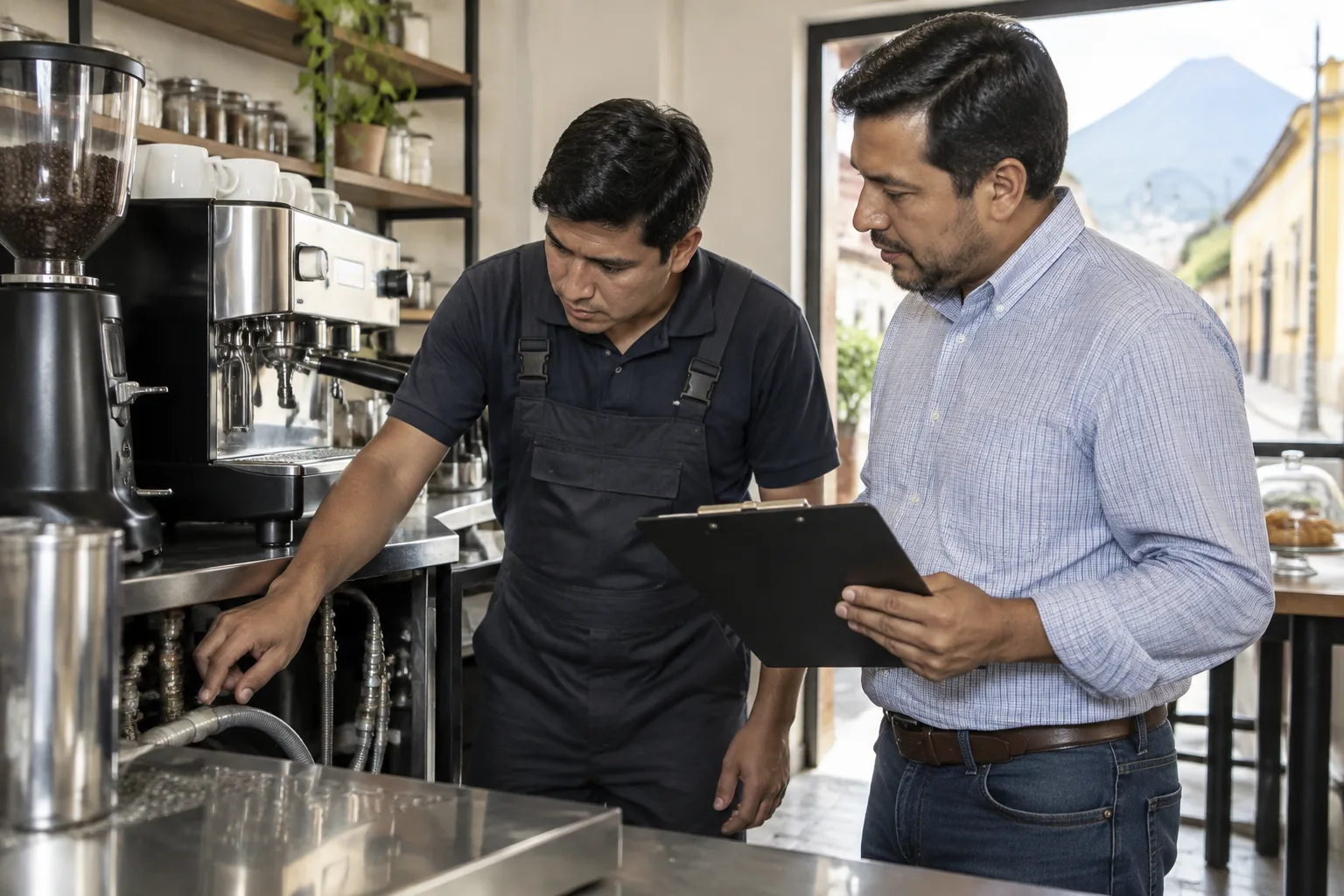
Receiving boxes is not the same as receiving operational equipment. Propose recording physical receipt, installation and functional acceptance in separate documents, or in clearly distinct sections of a single record.
The physical receipt record can note quantities, visible damage and missing components. Installation checks should verify the necessary connections and technical conditions. Finally, functional testing should demonstrate that the equipment performs its intended task under agreed conditions.
For example, if a machine needs to work alongside other devices, switching it on in isolation does not prove that the whole system works. Request a testing protocol suited to the business, prepared or reviewed by competent technical personnel.
Agree in advance:
- Who will carry out and witness the tests.
- Which results will allow the equipment to be accepted.
- How faults and outstanding issues will be documented.
- The deadline for resolving the issues identified.
- When a failed test will be repeated.
Avoid signing a declaration of full acceptance while issues remain outstanding. Seek advice on how to record express reservations, without assuming that such a note has legal effects that have not been checked.
4. Coordinate payments, remedial work and opening
Where commercially possible, negotiate a payment schedule linked to verifiable milestones. Define what evidence will confirm each milestone and how amounts relating to outstanding or defective equipment will be handled. Do not withhold payments unilaterally without first reviewing your obligations.
It is also worth agreeing who will cover transport, dismantling, reinstallation and retesting when a fault needs to be corrected. Ask about maintenance, spare parts and technical support available in Guatemala: an unclear warranty could leave you without a workable solution for a considerable period.
If essential equipment is delayed, establish how that delay will be managed alongside your commitments for opening the business. Any temporary replacement should have the necessary approvals and explicitly agreed financial terms.
Practical takeaway: before paying for equipment, obtain a detailed inventory, identify the responsible parties and agree an acceptance protocol. Buying equipment is not enough: you need to know when it will be considered properly delivered and how faults will be resolved.
Sources
- Franchises in Guatemala: choosing the purchasing company
- Franquicias en Guatemala: elige la sociedad compradora
- Franchising in Guatemala: check the permits you need to open
- Franquicias en Guatemala: verifica los permisos de apertura
- Franchises in Guatemala: assess the intermediary
- Franchising in Guatemala: align your premises lease with your franchise agreement
- Franquicias en Guatemala: evalúa al intermediario
- SUPSRIHTEWOCHCIA &E AlOMlWSTRACIOH TRIBUTARIA