Unser Schopp plans village shop expansion through franchising
Unser Schopp wants to bring more village shops to rural Germany. Alongside profit-sharing loans, a franchise model is intended to support its growth.
Published
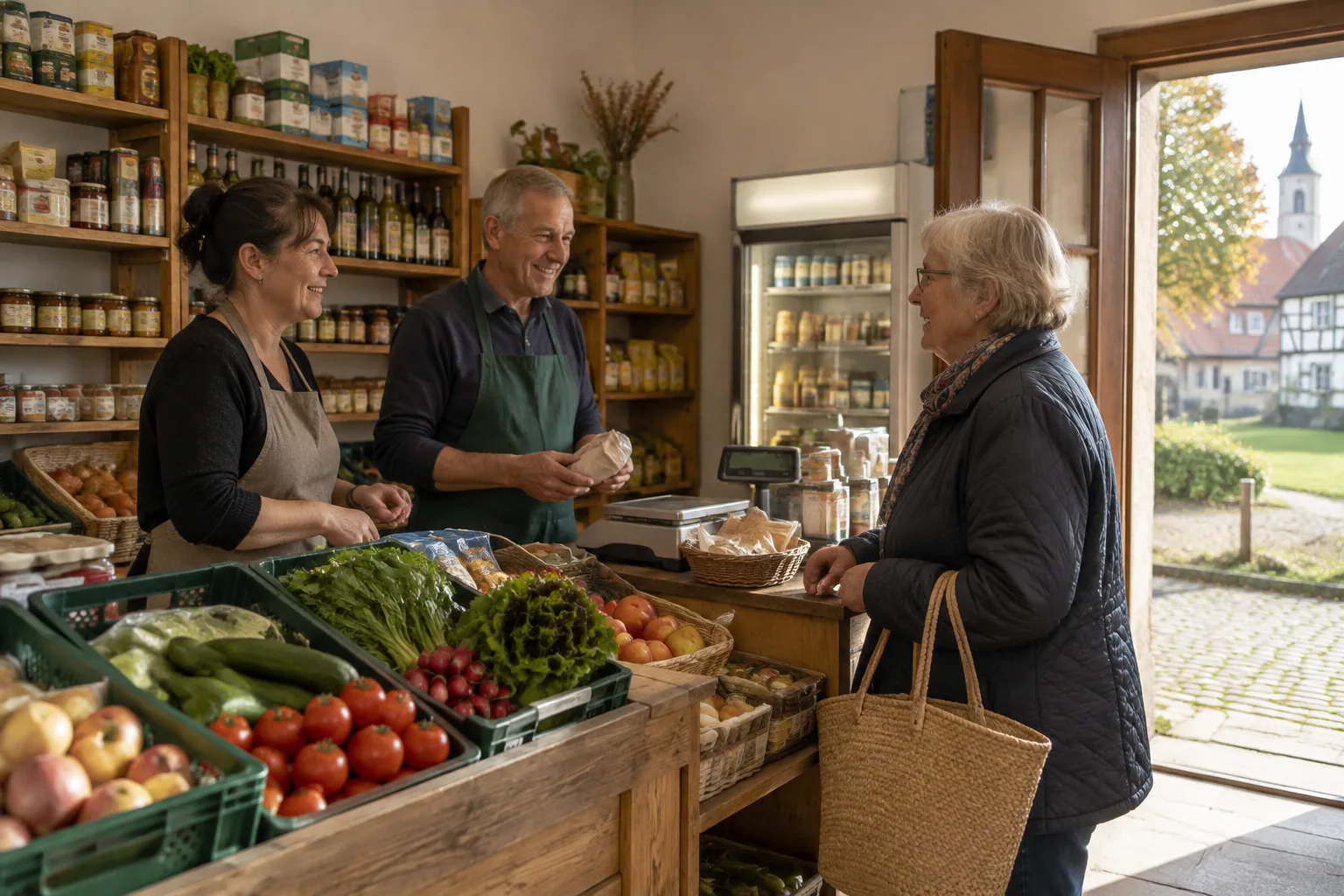
A village shop providing everyday essentials and a place to meet: under the name Unser Schopp, Sandy Hoppert and Marius Schiel have been running a round-the-clock shop in Burgkemnitz for almost two years. They now want to take their concept from the German state of Saxony-Anhalt to other locations, with franchising set to play a part. The announced expansion is ambitious, but still at an early stage.
From the first shop to plans beyond the region
Unser Schopp’s only location so far is in Burgkemnitz, part of the municipality of Muldestausee in the Anhalt-Bitterfeld district. Across 72 square metres, the founders combine the village shop concept with 24-hour opening. Hoppert and Schiel also jointly run an organic food shop in Zörbig.
According to a report by German regional broadcaster MDR dated 7 November 2026, they have set a clear target for developing their village shop concept. “Our vision for the next twelve months is to establish 30 shops, around 26 of them in Saxony-Anhalt,” Schiel told the broadcaster. The word “vision” matters here: the figure describes their expansion ambitions, not an existing network or a set of openings all scheduled with firm dates.
According to the founders, interest already extends beyond the state’s borders. Schiel reported that they had received around 200 enquiries from across Germany. This response indicates the attention the concept is attracting. It should not, however, be equated with 200 planned locations or signed franchise agreements. For those following Germany’s franchise market, the key point of interest is therefore the next step: taking a format currently operating in just one location into other communities.
Different timelines for Radegast and Rösenbeck
The more concrete proposals show that individual projects are at different stages. In Radegast, the report states that construction is at least scheduled to begin in 2026. This does not imply that the shop will also open that year.
The project in Rösenbeck, in North Rhine-Westphalia, is further advanced. Based on the plans at the time of the report, a shop is expected to open there before the end of 2026, provided everything goes as intended. This announcement is therefore also conditional and should not be read as confirmation that the shop has already opened.
Further shops are planned in Lower Saxony and Baden-Württemberg. Although the founders’ main focus is Saxony-Anhalt, their ambitions are not confined to their home region. These projects demonstrate the intention to expand beyond it, without establishing a single timetable for all locations.
This distinction is important when assessing growth: an existing shop, a planned construction start and a proposed opening each represent a different stage of development. It also remains unclear which operating arrangements will ultimately apply to each of the announced locations.
Franchising as another route to running a village shop
The expansion plans explicitly include a franchise model. Hoppert and Schiel want to reach people who would like to open their own village shop using a concept already in practical operation. Franchising is therefore one proposed route to growth alongside other approaches, rather than a description of an established nationwide network of partners.
The starting point for future partners is the Burgkemnitz shop, where the format has been operating for almost two years. The next task is to turn this single business into a model that other operators can adopt. The announced expansion and the development of the franchise offering are therefore linked, but they are not the same thing.
The founders have also received recognition: Hoppert and Schiel were named state winners in the KfW Award Gründen 2026, a German entrepreneurship award. This accolade comes as they plan their expansion. It should, however, be considered separately from the question of how many additional shops actually open and how the future franchise model develops.
Providing capital is not the same as becoming a franchise partner
To finance further locations, the entrepreneurs are looking to private individuals as well as conventional funding models. Interested investors can provide capital through what are described as profit-sharing loans. In return, they are offered a base rate of interest and a share of the profits of the relevant village shop.
This financial investment should be distinguished from the announced franchise offering. While the loan model concerns financing a shop, the franchise model is aimed at people who want to open a village shop of their own. Both approaches can contribute to expansion, but they involve different forms of participation.
Practical takeaway: Anyone interested in Unser Schopp should first clarify whether they want to operate a shop themselves or invest capital. Prospective franchise partners should also look closely at the development stage of their preferred location: the growth vision is no substitute for a detailed site plan or a review of the eventual contractual terms.