Suppliers and sourcing when franchising in Colombia
Organise suppliers, purchasing and contingency plans before franchising your business in Colombia, with clear rules and contractual responsibilities.
Published
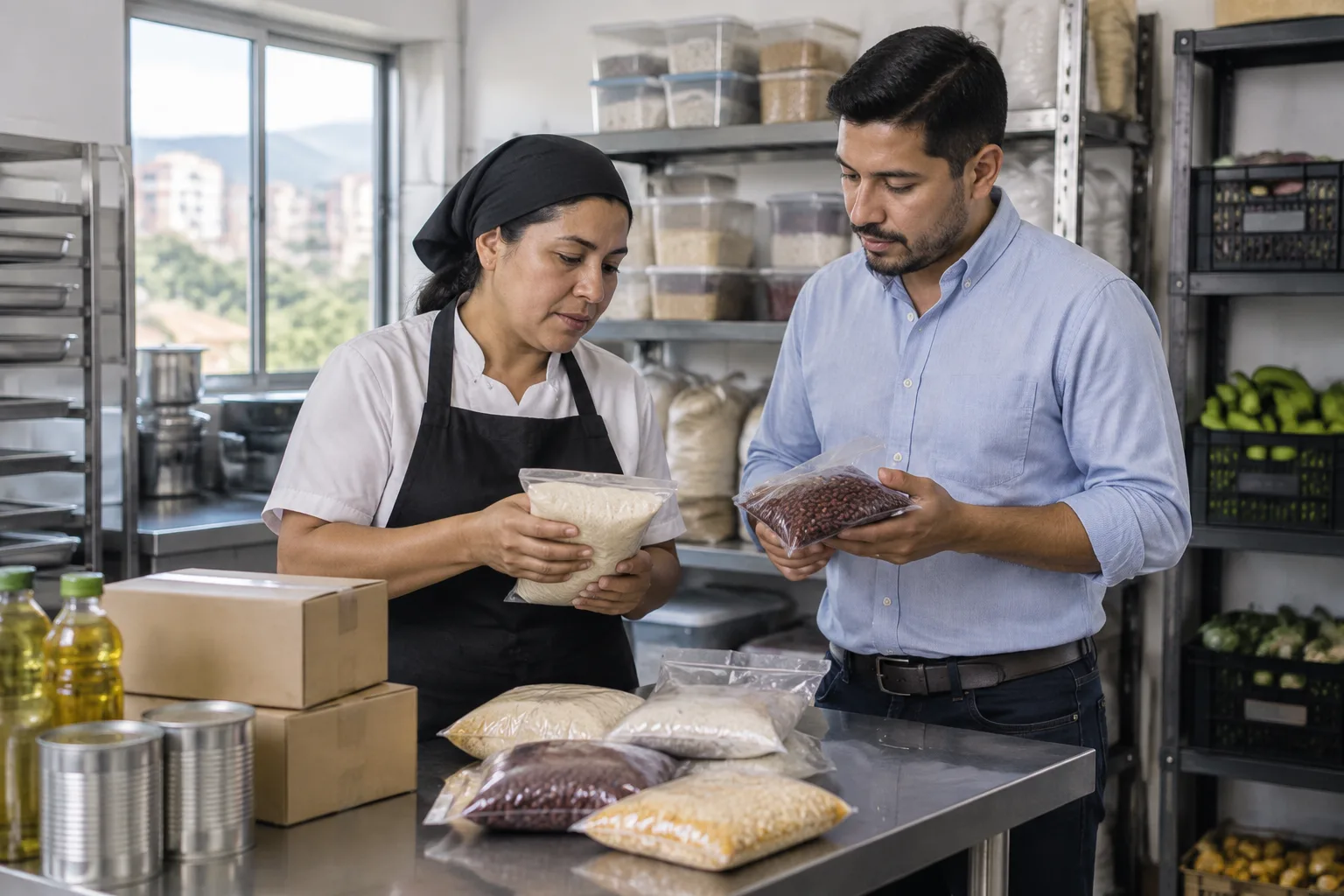
A business can run well from a single outlet yet lose consistency when it opens locations operated by third parties. A supplier that handles orders by phone may not be able to serve other cities or maintain the same terms. Before expanding your franchise network in Colombia, turn sourcing into a system you can verify: what is purchased, who supplies it, how quality is controlled and what happens if an item is unavailable.
1. Decide which purchases need central control
Not all supplies need the same approach. A signature recipe, a safety-critical component or packaging that preserves the product calls for different controls from those applied to office stationery. Requiring a single supplier for everything can increase costs without improving the customer experience.
Divide purchases into three groups:
- Critical supplies: affect brand identity, safety or performance. They need precise specifications, traceability and acceptance criteria.
- Equivalent supplies: can come from different manufacturers, provided they meet measurable requirements for composition, size, strength or functionality.
- Local purchases: can be left to the franchisee, subject to basic quality and compliance requirements.
Prepare a specification sheet for each critical item. Include its characteristics, transport and storage conditions, shelf life where relevant, and grounds for rejection. Avoid descriptions such as ‘superior quality’: two buyers may interpret them differently.
This classification should help you justify each restriction. If a mandatory purchase does not protect a specific feature of the business, consider whether it really needs to be centrally controlled.
2. Check suppliers’ actual capacity
A good relationship with a supplier is not proof that it can support expansion. Ask for information about available capacity, geographical coverage, delivery times, minimum orders and returns procedures. Check its commitments against delivery records, rather than relying solely on sales promises.
Calculate the total cost of getting supplies to the outlet: purchase price, transport, storage, losses and stock financing. A cheap item can prove expensive if it requires large orders or arrives with too little shelf life remaining.
Before approving new locations, check:
- Whether the supplier delivers there directly or uses intermediaries.
- Which terms change according to volume and distance.
- How it communicates price adjustments and product changes.
- What evidence it provides of compliance with applicable permit or health requirements.
- Who handles shortages, defects and complaints.
Set simple performance indicators: order completeness, on-time delivery, rejection rates and response times. Also decide who will review this information and how often.
Where volume discounts or benefits for the franchisor are involved, explain in the contract how they will be handled. Transparency about these incentives helps prevent disputes and makes it possible to assess whether mandatory purchasing remains reasonable for the franchisee.
3. Put the rules into the contract with legal support
In Colombia, franchising is an ‘atypical’ contract: there is no specific, comprehensive legal framework governing this type of agreement. The general rules of the Commercial Code and Civil Code apply, including good faith, alongside the rules relevant to each business activity.
The draft decree published by Colombia’s Ministry of Trade, Industry and Tourism (MinCIT) in 2021 should not be presented as legislation in force. Its proposal for an offering circular to be provided twenty working days in advance does not, simply by appearing in that document, create a general legal obligation.
Competition law also matters for mandatory purchasing and supplier agreements, particularly Law 155 of 1959 and Decree 2153 of 1992. Law 256 of 1996 governs unfair competition. Do not assume that every exclusive supply arrangement is valid: its justification, scope and effects require legal analysis.
The contract and its schedules should distinguish:
- Who sells and invoices: the franchisor, an affiliated company or an independent supplier.
- Who is responsible: for delivery, quality, warranties and complaints handling, without overriding mandatory legal responsibilities.
- How the approved supplier list is updated: criteria, communication and transition arrangements.
- How an alternative is approved: documentation, testing, the person responsible and the agreed response deadline.
If goods are sold to consumers, also consider Law 1480 of 2011. The internal allocation of responsibilities does not remove consumer rights or the legal obligations that apply to producers and suppliers.
4. Prepare an alternative before the first shortage
Identify the supplies whose absence would bring operations to a halt. For each one, establish a technically validated alternative or a procedure for temporarily withdrawing the affected product. Substituting items without assessment can compromise quality, safety and the accuracy of information given to customers.
For example, if an ingredient is unavailable, simply authorising ‘something similar’ is not enough. Composition, allergens, storage requirements and the finished result must be reviewed, as appropriate.
Set out who activates the contingency plan, how outlets are informed and what evidence is needed before returning to the usual supply arrangements. Adjust safety stock levels to consumption, replenishment lead times and expiry dates, rather than building up stock without a clear rationale.
Practical takeaway: before offering the franchise, prepare a supplies matrix, verifiable supply commitments and a contingency procedure. If you cannot explain how each outlet will receive what it needs to operate, your sourcing arrangements still need work.
Sources
- ¿Cómo se elabora un contrato de franquicia?
- Inicio | MINCIT - Ministerio de Comercio, Industria y Turismo
- Leyes desde 1992 - Vigencia expresa y control de ...
- Requisitos para ser franquiciado en Colombia: guía 2024
- Análisis del contexto normativo del contrato de franquicia en Colombia y
- Superintendencia de Industria y Comercio.
- Cómo crear una franquicia en Colombia: 9 Pasos
- Marco Legal Franquicia Colombia | PPT