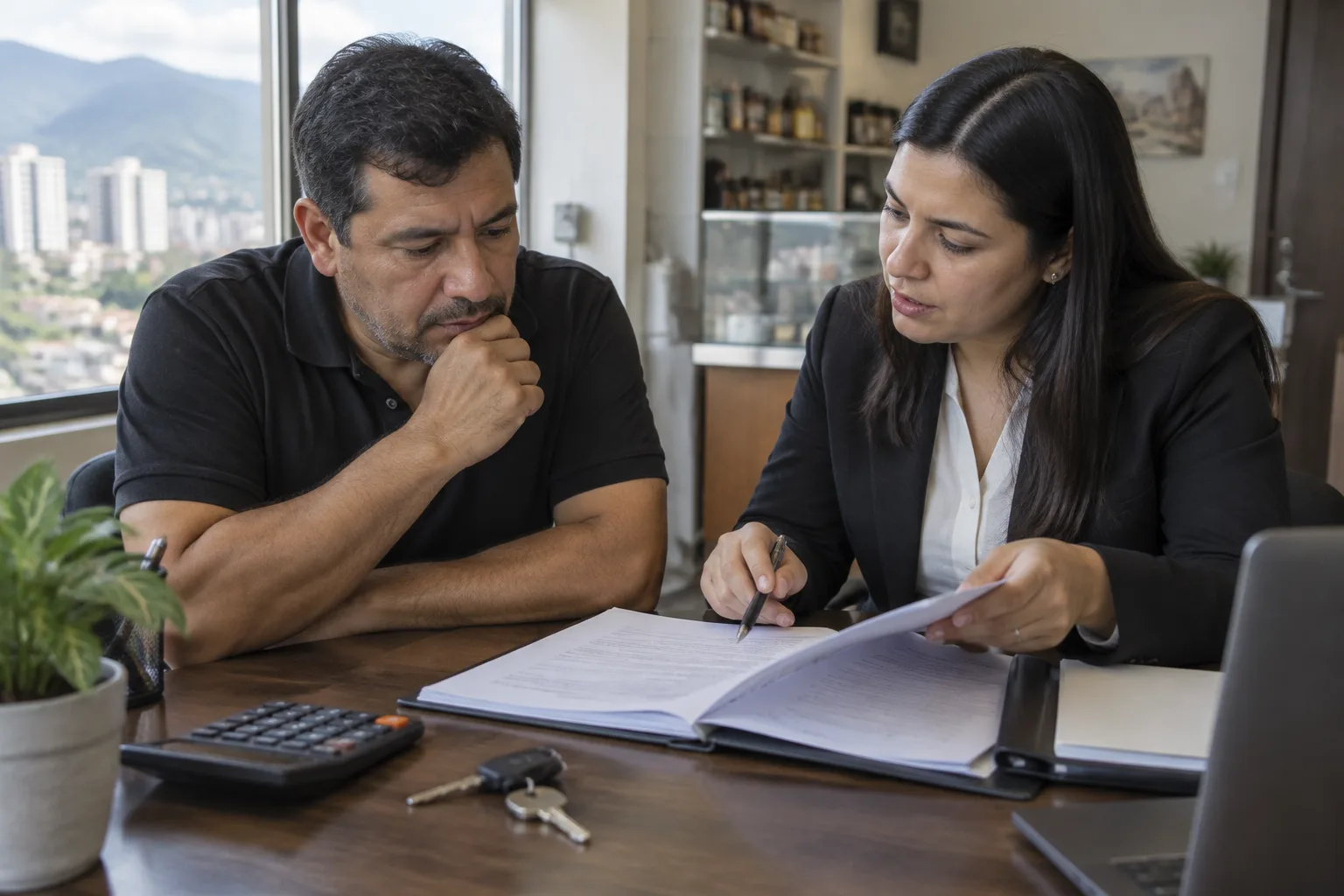
Franchises in Venezuela: how to validate sales projections
Learn how to check a franchise’s projections and calculate how much cash you will need before committing your investment.
Published

A sales projection does not prove that a franchise will be profitable. Before buying, you need to know where the figures come from, whether they relate to a comparable outlet and how much cash you would need if the business got off to a slower start than expected. In Venezuela’s franchise market, these checks help you choose a brand based on evidence, not just a persuasive presentation.
1. Ask for data that lets you reconstruct the projection
Request a written explanation of the trading assumptions: daily transaction numbers, average transaction value, trading days, seasonality and the expected time needed to reach a steady level of trading. A single annual figure conceals important differences between the first few months and an established outlet.
Ask for a clear distinction between historical results, estimates and sales targets. If you are shown other outlets’ performance, establish:
- Whether they are owned by the franchisor or run by franchisees.
- Their city, location, floor area and how long they have been operating.
- The period covered by the data and the currency used.
- Whether sales figures include taxes, discounts, returns or home deliveries.
- How many outlets are included in the sample and how they were selected.
Showing you the best-performing outlet is not enough. Ask for information on differences between outlets and, where possible, on recent openings and outlets that have closed. A refusal to share data does not, by itself, prove wrongdoing, but it limits the confidence you can place in the projection.
It is reasonable to accept aggregated or anonymised data and to sign a confidentiality agreement. What matters is being able to understand and test the assumptions without demanding other people’s personal information.
2. Check whether those results are relevant to your outlet
A brand can perform well without necessarily justifying an investment in a particular location. Compare footfall, opening hours, accessibility, nearby competition and customer profiles. Visit the site on different days and at different times; one busy visit does not necessarily reflect the whole week.
Reconstruct sales using a simple calculation:
Estimated monthly sales = daily transactions × average transaction value × trading days.
Then challenge each factor. Can the outlet handle that number of transactions? Does the proposed pricing match what nearby customers actually pay? Does demand depend on promotions that reduce margins?
With permission from those providing the information, cross-check the figures against sales reports, accounting summaries or other relevant supporting records. Also speak to franchisees in comparable locations and ask how long it took their revenue to stabilise, not just how much they sell today.
In Venezuela, record the currency of each income and expense item. If you convert amounts, document the date, exchange rate and conversion basis used. Do not combine historical sales converted on one basis with current costs calculated on another: this can create an illusion of profitability.
3. Translate sales into cash requirements
Making sales is not the same as having cash available. Work with an accountant to prepare a monthly cash-flow forecast that includes fit-out costs, equipment, opening stock, deposits, payroll, rent, utilities, taxes and contractual payments. Also include stock replenishment, maintenance and realistic remuneration for your own work.
Separate pre-opening outlays from operating expenses. If you plan to use finance, include interest, fees and principal repayments according to the proposed repayment schedule; do not treat a loan as business income.
Prepare three scenarios: one supported by the available data, another with slower sales, and a third combining lower sales with higher costs or opening delays. You do not need arbitrary percentages: justify each variation using quotations, the condition of the premises and comparable businesses’ experiences.
Identify the largest cumulative cash shortfall and add a contingency reserve based on a reasoned assessment. This helps you establish how much capital you need beyond the investment figure advertised by the brand. If you can only fund the favourable scenario, consider reducing your commitment or reconsidering the purchase.
4. Document the information and understand its legal implications
Venezuela has no comprehensive franchise-specific law or general mandatory pre-contractual disclosure regime equivalent to those in some other countries. A Circular de Oferta de Franquicia, or franchise disclosure document, may be used to provide information, but it should not be presented as a general legal requirement in Venezuela.
The relationship is governed primarily by the agreed contractual terms, within the limits of the Civil Code, the Commercial Code and other applicable rules, including those covering tax, employment, intellectual property and competition. Procompetencia’s historical Guidelines for the Evaluation of Franchise Agreements addressed competition issues; they are not equivalent to a financial disclosure law.
Ask for any projections supplied to be dated, identify who issued them and explain their limitations. With advice from a local lawyer, review how the contract deals with that information and any statements about profitability. An estimate is not a guarantee, but nor should it be confused with a verified result.
Practical conclusion: only buy when you can reconstruct the projected sales, explain the risks and fund an unfavourable scenario without relying on verbal promises.
Sources
- Elementos esenciales para la constitución y protección de ...
- Marco legal de las franquicias en Venezuela
- Marco jurídico de las franquicias en Venezuela - Blog Banesco
- “Franquicia” -clave al éxito económico
- www.legaltica.com › ve › necesito-contrato-de-licencia-o-franquiciaContrato de franquicia o licencia seguro para su marca en...
- Franquicias en Venezuela: Cómo Crear o Comprar una ...
- Franquicia de Venezuela. | PDF
- De la franquicia a los contratos de adhesión