BT Games plans new store format as SA footprint falls to three
BT Games is developing a new store concept after its South African footprint shrank from more than 50 outlets to three in Gauteng.
Published
BT Games is developing a new store concept after its South African network contracted from more than 50 outlets to just three. The specialist gaming retailer told MyBroadband it intends to roll out the format once suitable premises have been secured, as it adapts to customers buying games digitally rather than on physical discs.
Three remaining stores, all in Gauteng
According to MyBroadband’s report on 30 October 2026, BT Games’ online store finder listed only three operating outlets as of 28 October: Clearwater Mall, the Mall of Africa and Menlyn Park Shopping Centre. All are in Gauteng.
That represents a substantial retreat from the retailer’s peak between roughly 2015 and 2017, when it had more than 50 stores across South Africa. By the end of 2017, a company catalogue already showed a reduced network of 45 outlets.
Even the original Northgate Mall store in Johannesburg has closed. BT Games began with that single location and was incorporated in March 2005, with Launa Bagnall and Jennifer Ann Wood leading the business from its inception.
MyBroadband describes BT Games as the country’s remaining specialist bricks-and-mortar franchise selling video games, gaming peripherals and merchandise. Its changing footprint therefore offers South Africa’s franchise community a particularly focused example of a retail model being reshaped by digital distribution.
Digital purchases change the store’s role
The shift away from physical games is central to the retailer’s contraction. Customers have moved towards platforms such as Steam for PC games and the PlayStation and Xbox digital storefronts, reducing demand for discs sold across a shop counter.
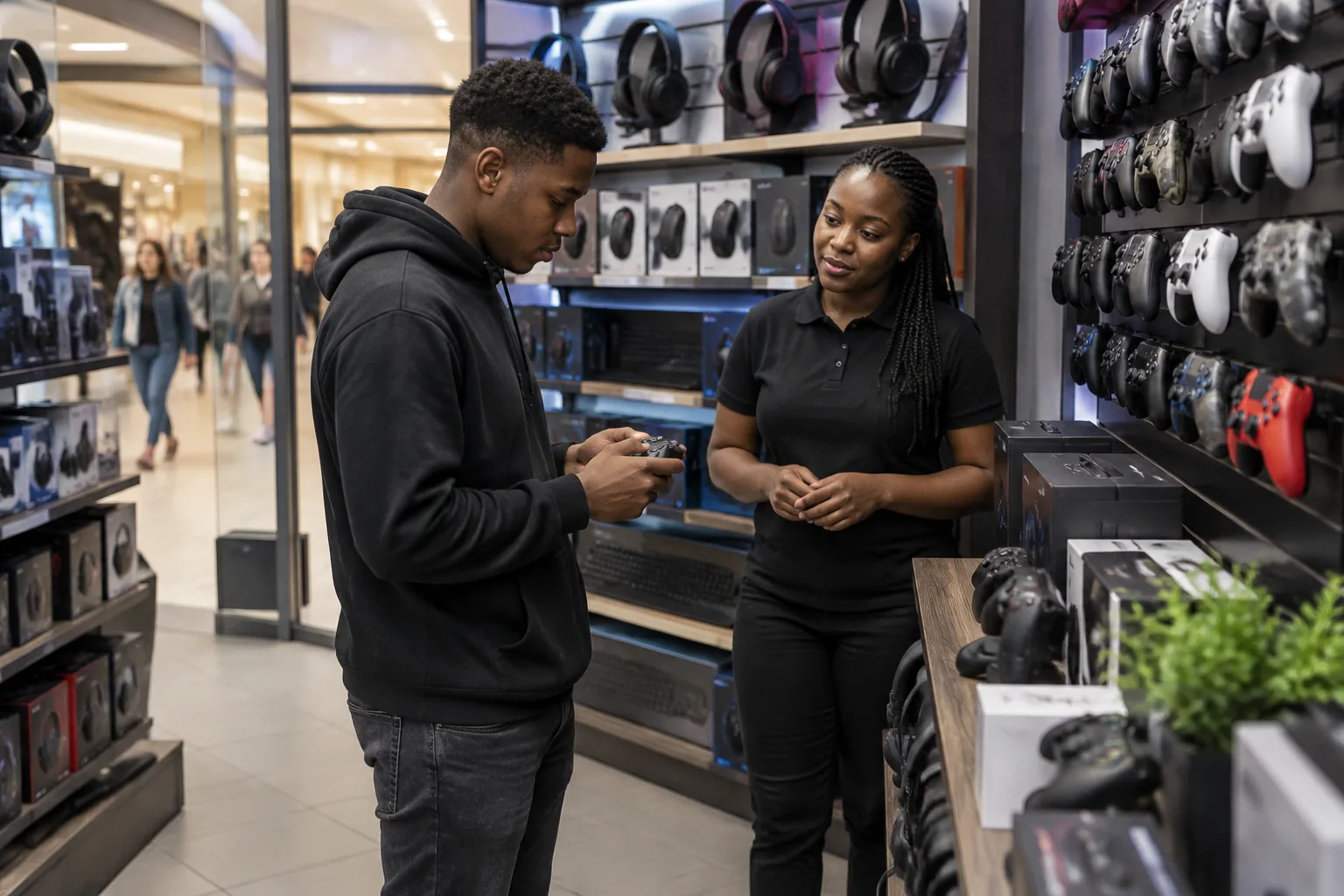
BT Games responded by shifting towards gaming peripherals. The company told MyBroadband that hardware and peripherals now dominate its sales, although game launches continue to drive purchases in those categories.
That distinction matters to the proposed reinvention. New games still generate business, but the products customers buy from a physical outlet have changed. A store designed primarily to stock and sell software is not necessarily suited to a business increasingly centred on equipment and accessories.
“Our current store model was built around software,” BT Games told MyBroadband. “The stores are limited in space and no longer align with the company’s direction or state of the gaming market.”
The company’s explanation connects the proposed format change directly to both its merchandise mix and the limitations of its existing shops, rather than presenting it simply as a plan to replace closed outlets.
A new concept depends on suitable premises
Asked whether it was considering new outlets in the coming years, BT Games confirmed that it was developing a new store concept.
“We’ll roll it out as soon as we have secured suitable premises,” the retailer said.
Its description of the intended direction was brief: “Fewer stores. Larger platform.” That signals a move away from the extensive physical network it previously operated, but should not be read as a confirmed national expansion programme.
The immediate commitment is to a different concept, with implementation dependent on finding appropriate locations. The retailer’s comments also make clear that the existing software-led format is no longer the model it wants to pursue.
“This transition will enable us to align more closely with how most of our community prefers to access and play games today,” BT Games said.
What the shift means for franchise planning
For South Africa’s franchise community, the BT Games story highlights the distinction between demand for a product category and demand for a particular retail format. Customers can remain active gamers while purchasing their games through channels that bypass physical shops.
The company’s experience also puts store suitability alongside location count. Its stated concerns are not only about having fewer outlets, but about whether the space and layout support the products that now account for its sales.
Practical takeaway: Prospective franchisees assessing a retail concept should test whether its premises, product mix and sales channels match current customer behaviour. BT Games’ next step is a new format, not simply more of the same stores.