Luckin Coffee Reaches 100 Stores in Singapore
Luckin Coffee’s Bugis Junction opening takes its Singapore network to 100 stores, sharpening competition in the branded coffee market.
Published
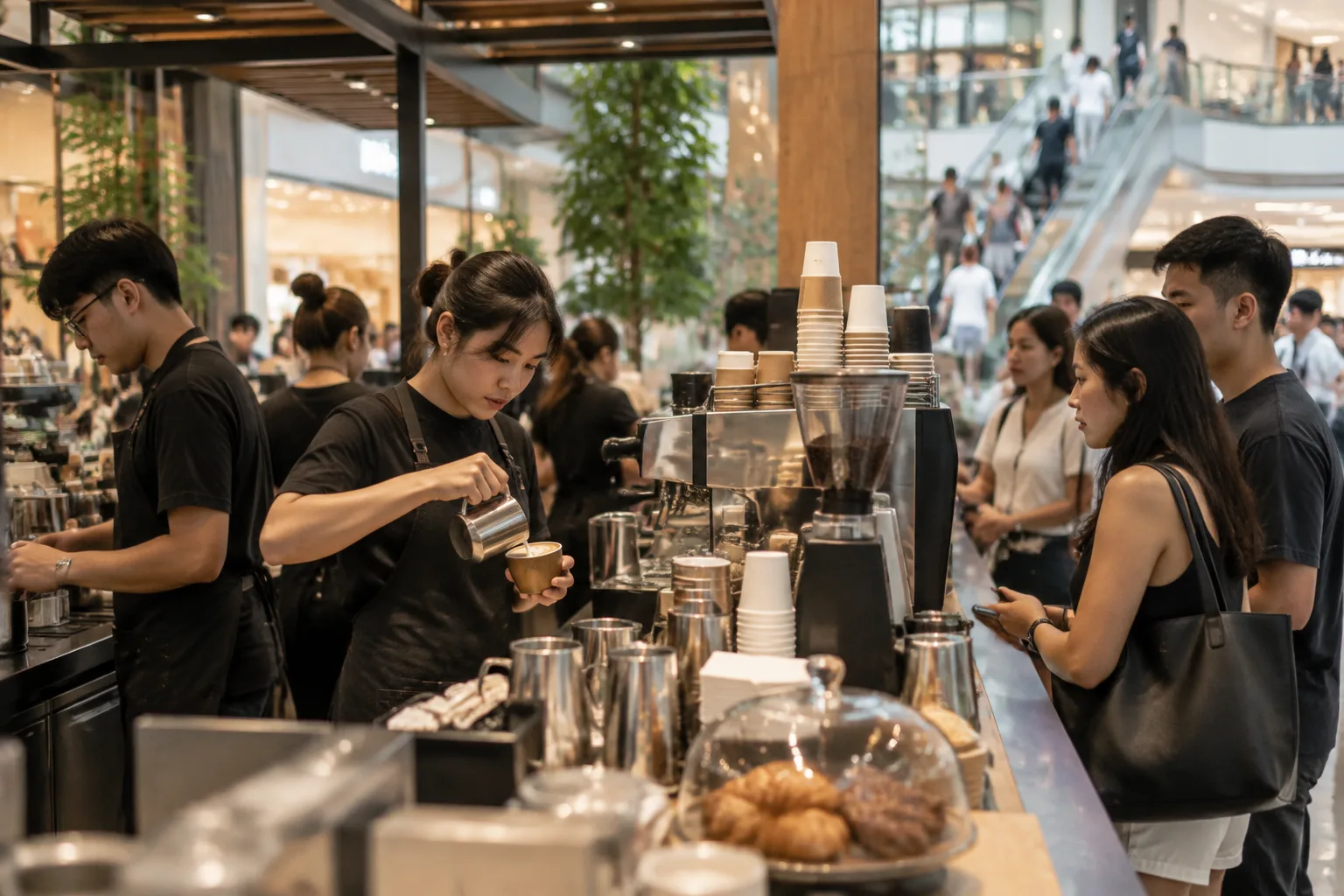
Luckin Coffee has reached 100 stores in Singapore with a new outlet at Bugis Junction shopping centre, according to World Coffee Portal’s report on 28 September 2026. The milestone comes three-and-a-half years into its Singapore expansion and offers the franchise community a fresh benchmark for assessing competition in the branded coffee shop market.
Bugis Junction marks a network milestone
The Bugis Junction opening brings Luckin’s Singapore network to a scale that places it ahead of The Coffee Bean & Tea Leaf by outlet count, World Coffee Portal reported. The Chinese coffee company has also narrowed the gap with Starbucks.
That is a significant change in the competitive landscape, although the report’s available details do not give the precise outlet totals for either rival. The supported comparison is therefore one of relative network size: Luckin has overtaken one established competitor and moved closer to another.
The timing is also notable. World Coffee Portal describes Luckin’s growth as taking place while many competitors in Singapore are slowing expansion, closing stores or exiting the market. Its latest opening is consequently more than an isolated addition to a shopping centre: it marks continued expansion against a less uniform backdrop for coffee operators.
Store numbers show reach, not profitability
Reaching 100 stores in three-and-a-half years demonstrates the pace and extent of Luckin’s physical expansion. It does not, on its own, establish the financial performance of those locations.
For Singapore’s franchise community, that distinction matters when using a prominent chain as a market benchmark. Outlet count can help indicate how widely a brand is represented, but it is not a substitute for evidence about sales, operating costs, customer retention or returns at individual stores.
The supplied report does not disclose Singapore store-level profitability, like-for-like sales or the investment required for the Bugis Junction outlet. Nor does it establish that the new location is franchised or that Luckin is offering franchise opportunities in Singapore. The milestone should not be interpreted as an invitation to invest in the brand.
Instead, it provides a concrete reference point for competitive assessment: an operator has built a 100-store network while several competitors are taking a more cautious approach or reducing their presence.
An uneven market for coffee expansion
World Coffee Portal characterises Singapore as a branded coffee shop market that many international giants struggle to crack. Luckin’s expansion sits alongside that warning rather than cancelling it out.
The contrasting trajectories suggest that a single description of the market as either expanding or contracting would be too broad. One brand’s growing network and other operators’ retrenchment can occur at the same time. Neither development alone establishes the prospects of a proposed new coffee business.
For prospective franchisees, the useful question is therefore not simply whether Singapore can accommodate more coffee outlets. It is whether a particular proposition can support its costs and attract sufficient demand at a particular location.
Bugis Junction is the named location behind Luckin’s latest milestone. However, the research does not provide footfall figures, lease terms, outlet size or trading results for that store. Those gaps limit any attempt to use this opening as evidence for the viability of another shopping-centre location.
What the franchise community should assess
Luckin’s milestone is relevant to coffee franchise planning because it changes the scale of the competitive benchmark. A proposed outlet should be assessed against the choices already available to customers, rather than against a broad assumption that a familiar brand will be enough.
Practical due diligence could include mapping nearby coffee operators, comparing their offers and checking the assumptions behind projected transactions and average spending. Prospective franchisees should also request evidence supporting the proposed outlet’s costs and sales forecasts, rather than treating another chain’s growth as proof of demand for their own concept.
The practical takeaway is straightforward: use Luckin’s 100-store milestone as a prompt to revisit local competition, not as a shortcut to an investment decision. Network growth is newsworthy; the viability of an individual outlet still needs separate evidence.