Franchising a Hong Kong Business: Setting Clear Terms for Equipment Repairs, Downtime and Back-up Arrangements
Equipment breakdowns are not just a maintenance issue: they affect franchisees’ revenue and the service customers receive. Before offering franchises, head office should test repair procedures and clarify maintenance duties, shutdown decisions, replacement equipment and responsibility for costs.
Published
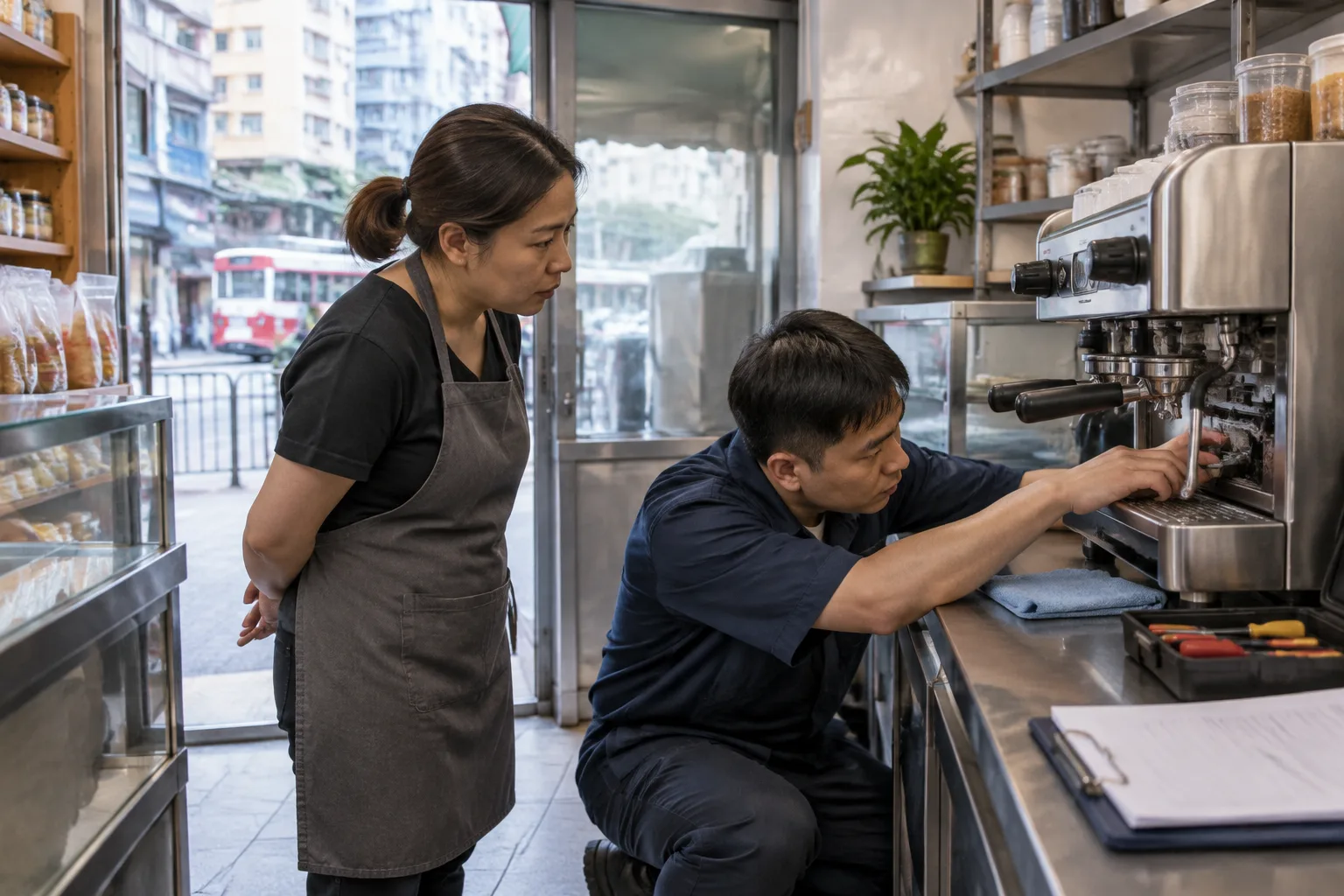
When equipment breaks down at a company-owned outlet, the founder can often resolve the problem with a single phone call. At a franchised outlet, however, head office, the equipment supplier and the franchisee may all be involved, with no clear agreement on who arranges repairs, pays the bill or authorises reopening. To build a reliable franchise network, Hong Kong businesses should turn informal support into workable arrangements before offering franchises. Franchisees should not be left paying fees only to find that no one takes responsibility when equipment fails.
1. Establish an equipment responsibility register during the pilot
A maintenance system should start with an equipment inventory, not a blanket statement that ‘franchisees are responsible for maintenance’. For each critical item, record its owner, model, warranty period, repair contact and the impact a breakdown would have on operations. Responsibilities may differ depending on whether equipment is loaned by head office, purchased by the franchisee or leased from a third party. Requiring franchisees to buy specified equipment does not automatically make head office responsible for repair costs.
Group equipment by the consequences of downtime: which failures would close the entire outlet, which would affect only some services, and which could be managed using alternative tools. Where safety is involved, lost revenue must not be the sole basis for deciding whether equipment can remain in use.
During the pilot, have outlet managers report faults through the formal procedure. Record the time taken from reporting to receiving a response, inspection, obtaining parts and returning the equipment to service. Tests should include out-of-hours incidents and situations where the supplier cannot attend on the same day, with drills conducted without putting staff or customers at risk. If head office still needs the founder’s personal contacts to resolve problems, it is not yet ready to promise that level of support to franchisees.
2. Put procedures in the manual and responsibilities in the agreement
The operations manual should tell staff on duty what to do first after a breakdown: stop using the equipment, isolate it, record fault messages and notify the designated contact. Include only basic checks that have been confirmed as safe and suitable for staff to carry out. Untrained staff must not be asked to dismantle equipment or deal with electrical faults.
The franchise agreement should address rights and responsibilities, covering at least:
- Routine maintenance: Who cleans and checks equipment, who keeps records, and which tasks must be carried out by qualified personnel.
- Repair authorisation: Who can call out a technician, approve quotations and authorise replacement parts, and whether franchisees may act independently in an emergency.
- Allocation of costs: How normal wear and tear, misuse, inadequate maintenance and pre-existing defects are established, and who pays in each case.
- Conditions for reopening: Who confirms that equipment is safe to use, and what inspection or repair documentation is required.
Hong Kong has no legislation specifically governing general commercial franchising, nor a dedicated franchise registration or statutory franchise disclosure regime. The relationship is governed primarily by contract law, including common law, and applicable legislation such as the Misrepresentation Ordinance. Equipment supply may also fall within the Sale of Goods Ordinance, while exclusion or limitation of liability clauses need to be considered in light of the scope of the Control of Exemption Clauses Ordinance. A Hong Kong solicitor should review the actual responsibilities in light of the transaction and the nature of the equipment. Do not assume that a simple ‘no liability’ clause is enough to exclude responsibility.
3. Match repair commitments to suppliers’ capabilities
The support head office promises franchisees should not exceed the service the supplier has actually agreed to provide. In particular, distinguish between responding to a fault report, sending a technician to the site and completing the repair: these are three different milestones. If parts availability is outside your control, avoid guaranteeing that trading will resume within a fixed period.
Before offering franchises, check the supplier’s service coverage, out-of-hours arrangements, spare parts stock, travel surcharges and whether unauthorised repairs could affect warranty cover. If the equipment warranty or maintenance cover is held solely in head office’s name, confirm whether franchised outlets can report faults directly and whether the supplier recognises their entitlement to cover.
Repair costs should also form part of each outlet’s operating budget. Estimate preventive maintenance, consumables, emergency call-outs and temporary equipment hire separately, using pilot records or supplier quotations. Do not treat repairs that ‘may be free’ during the warranty period as evidence that there will be no costs throughout the franchise term. Where responsibility has not yet been established, agree an interim payment and subsequent adjustment procedure in advance, so equipment does not remain out of service while the parties argue over the bill.
4. Plan alternatives for periods of downtime
Do not wait until equipment fails to discuss back-up arrangements. Depending on how critical the equipment is, head office can consider spare units, hire options or temporarily suspending selected services. Check that any replacement equipment meets safety, premises and practical operating requirements. If equipment is to be borrowed from another outlet, clarify responsibility for transport, installation, damage and return. Do not assume that another franchisee is obliged to help.
Any fees that continue during downtime should also be explained in advance. Turnover-based fees may be affected differently from fixed system fees or other flat charges. If reductions or waivers are available, specify eligibility criteria, supporting evidence, calculation methods and who approves them, rather than simply promising verbally to ‘sort it out at the time’. Compensation for lost revenue should also be treated separately from repair costs.
After every major breakdown, head office should document the cause, resolution time and additional costs, then use the findings to improve equipment selection and maintenance frequency—not merely to investigate whether staff followed procedures.
Practical takeaway: Before recruiting franchisees, run a fault-reporting drill for one critical piece of equipment and cross-check the responsibility register, repair terms and back-up plan. You are only truly ready when franchisees know, at the moment equipment goes down, whom to contact, who pays and how to restore service safely.
Sources
- 創業香港- 序言 - success@tid.gov
- BUSINESS & COMMERCE - Community Legal Information Centre
- Starting a Business (Licensing, Registration & Regulations)
- COMPETITION LAW | Community Legal Information Centre (CLIC)
- 立法會六題:規管與特許經營相關商業行為 - 香港政府
- 慎閱特許經營權條文細則 爭本港司法管轄區解決條款
- 商業特許經營| 香港貿易發展局經貿研究 - HKTDC Research
- COMPETITION LAW