13 of Charmia’s 14 stores operate as franchises
Charmia’s Finnish network comprises 13 franchised stores and one company-owned store. Local warehouses are central to its operating model.
Published
Kitchen furniture chain Charmia’s Finnish network relies heavily on franchising: 13 of its 14 stores operate under franchise agreements. A company profile published by Finnish business newspaper Kauppalehti on 9 November highlights the model used by this family-owned business based in Loimaa, Finland, combining in-house component manufacturing with local warehouses and stores. Its first franchise agreements were signed in 1998, making this a long-established way of operating.
Franchising underpins the store network
Charmia’s only company-owned store is in Turku. Its other 13 stores across Finland operate under franchise agreements. This split shows that franchising is not simply a way to supplement company-owned retail operations, but the main operating model for the store network. The chain’s manufacturing and retail operations therefore form an integrated business in which franchised stores play a central role.
The first agreements, signed in 1998, place the model’s origins well before the adoption of the current Charmia name. Based on the article published in November 2026, franchising has been part of the company’s development for almost three decades. The current network of 13 franchised stores reflects the model’s established role within the chain, rather than signalling a new phase of expansion.
For those exploring Finland’s franchise market, Charmia offers a practical example of a chain model combining kitchen furniture sales and manufacturing. Alongside the shared brand, key elements include physical products, their manufacture and the local preparation of customer orders. The store count indicates the network’s reach, but the role of the warehouses and factory helps explain how the business works in practice. The number of outlets alone does not capture the full operating model: it is also important to examine how products move from the factory to the point where orders are prepared locally.
From Kalustetukku to the Charmia brand
The business was previously known as Kalustetukku. According to Kauppalehti, the official change to the Charmia brand took place around five years before the article was published, although Charmia had already been used as a product brand. The name change and the launch of franchising are therefore separate stages in the chain’s history: its first franchise agreements considerably predate the move to the current brand.
The company behind the brand, Charmia Group Oy, is a family-owned business based in Loimaa. It manufactures kitchen components at its own factory and also imports various fittings and mechanisms. The chain’s product range therefore includes imported parts as well as items made in-house. Nevertheless, its own factory remains a distinct part of the business.
Both manufacturing and product sourcing thus sit behind the brand. For anyone assessing the franchise model, this is an important distinction that a simple description of the store network would miss. Charmia’s structure extends beyond its stores to the company manufacturing the components. The current name brings these operations together under one brand, but the history of its independently operated store network began in the Kalustetukku era. This sequence helps distinguish the brand’s development from the length of time franchise agreements have been used to organise the chain’s retail operations.
Local warehouses shape the flow of goods
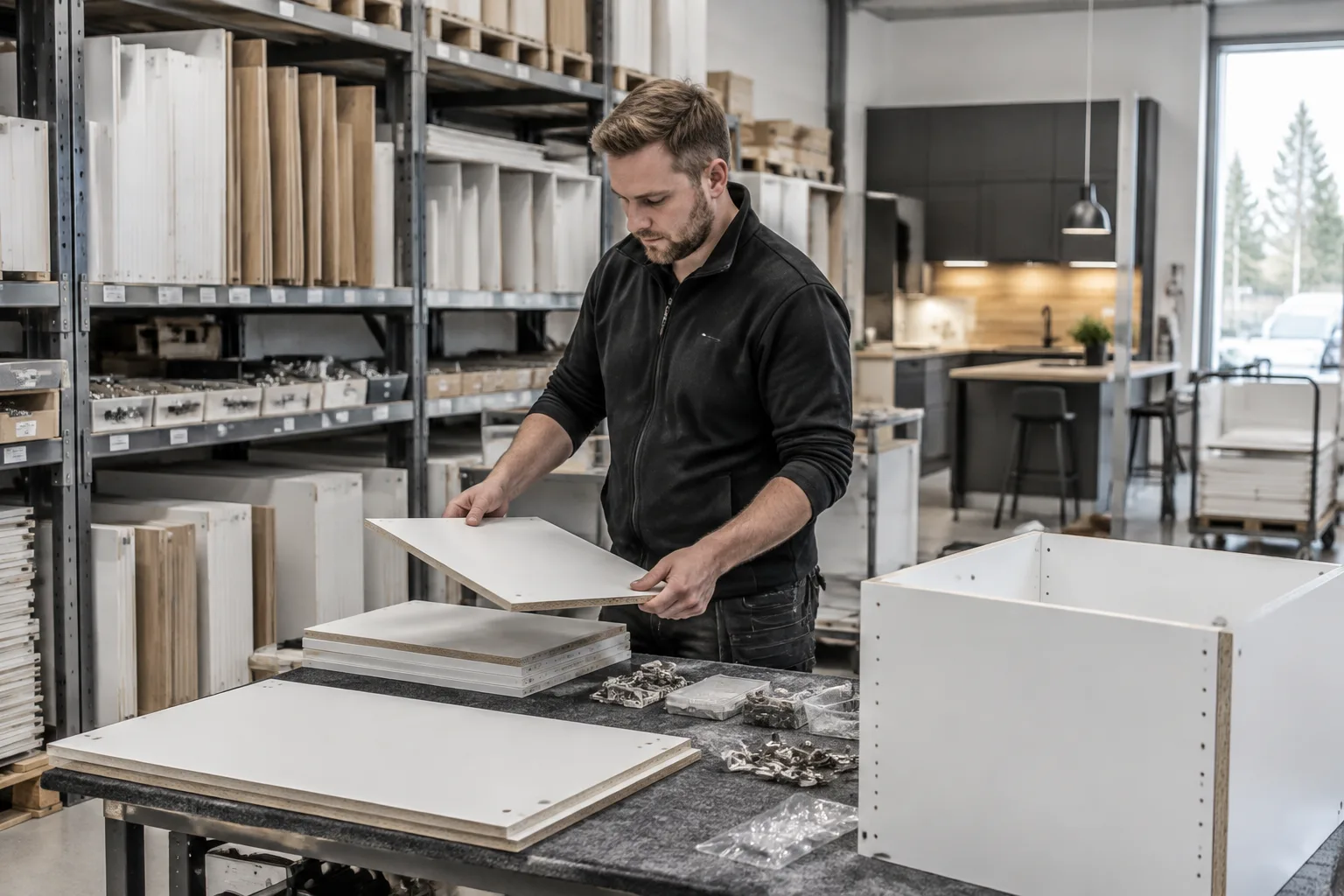
Under Charmia’s operating model, each customer’s order is prepared at a local warehouse. In the model described to Kauppalehti, the local element therefore concerns not only the store’s location but also order handling. Warehouses form part of the process through which kitchen components move from production towards a complete customer order.
According to the company, this arrangement saves on packaging and transport costs because empty, pre-assembled cabinet carcasses are not shipped around Finland. The cost rationale therefore relates to the form in which goods are transported and the stage at which an order is put together. This is an operating principle described by the company, rather than a quantified calculation of savings.
In this model, the local warehouse is more than a place to store products: it is where the customer’s order is prepared. This links the warehouse directly to order fulfilment. When assessing the store network, it is therefore useful to look at this less visible part of the operation too. Customers see the shared brand, but the organisation of the flow of goods also matters behind the scenes. Charmia’s description makes this connection clear without requiring the benefits of the model to be inferred from store numbers alone. Alongside the location of manufacturing, the form in which products are transported and the place where orders are prepared are also important.
What should prospective franchisees consider?
Charmia’s example draws attention to three connected features: in-house component manufacturing, local warehouses and a store network operating predominantly under franchise agreements. Looking at these together gives a more accurate picture of the chain than the brand or outlet count alone. It also demonstrates why anyone exploring franchising should examine chains’ practical supply and delivery arrangements.
For someone considering a kitchen furniture franchise, relevant questions include warehouse space requirements, how order preparation tasks are divided, and the allocation of responsibilities between manufacturing, importing and the store. These are points for assessment, not claims about the terms of individual Charmia agreements. They can help prospective franchisees understand the premises, skills and day-to-day tasks that the proposed model requires.
Practical takeaway: assess a franchise chain through its flow of goods and division of responsibilities as well. In Charmia’s case, local warehouses and in-house manufacturing are central to a business in which 13 of the 14 stores operate under franchise agreements.