Spartao improves restaurant efficiency through franchising
Spartao, the company behind Itsuyaki, has converted some of its restaurants to franchises. It is also seeking to improve profitability through close monitoring of individual sites.
Published
Spartao, the company behind the Itsuyaki, Itsudemo and Seoul Good restaurant brands, has converted some of its restaurants to franchises to improve operational efficiency. In an interview published by Helsingin Uutiset on 18 October, the company discusses monitoring profitability, recruiting franchisees from its workforce and pursuing controlled growth. For those interested in Finland’s franchise market, the case offers a timely example of how franchising can form part of a restaurant network’s restructuring.
Franchising as part of improving profitability
Spartao Oy operates five Itsuyaki restaurants in the Helsinki metropolitan area, alongside Itsudemo and Seoul Good restaurants. The company also has Itsudemo Sushi Bar concepts in supermarkets across Finland. Itsuyaki is its newest brand, developed to bring something different to the Asian buffet format.
Zhifei Tang, project manager for Itsuyaki restaurants and a member of Spartao’s board, tells Helsingin Uutiset that some restaurants have been converted to franchises to improve operational efficiency. The change is one of several measures the company describes for developing its restaurant operations, rather than a separate expansion project.
The company monitors its restaurants’ profitability closely and closes underperforming sites where necessary. The interview links a reduction in staffing to these closures: employee numbers fell from 500 to 270 between 2021 and 2024. Developing the network has therefore involved not only opening new restaurants, but also withdrawing from sites whose results were insufficient.
According to Tang, annual turnover per employee has risen from around €35,000 to €70,000. He attributes this to improved performance at individual restaurants and the success of restaurants opened in recent years. The figure is therefore part of a broader shift involving changes to both the site network and the way operations are organised.
The figures need to be read alongside the changes
Turnover per employee is a specific measure highlighted in the interview. Its doubling shows a change in the relationship between turnover and employee numbers, but should not be equated directly with restaurant profit margins. Turnover and profitability are different things, although both matter when assessing a business.
Nor is it reasonable to treat franchising as the sole explanation for the change in this measure. Tang points to both improved restaurant performance and successful new openings. At the same time, the company has closed underperforming restaurants and reduced its employee numbers.
For the franchise sector, the key observation is the combination of measures. In Spartao’s account, franchising, site-level monitoring, closures and successful openings are all part of the same picture. Comparing a single metric does not establish how much of the change is attributable to each measure.
This distinction also matters to prospective franchisees. Company-level turnover per employee does not, on its own, indicate the profit of an individual franchised restaurant or the franchisee’s earnings. Assessing a site therefore requires a review of figures specific to that restaurant.
Franchisees are sought first among existing staff
According to Tang, Spartao approaches its existing staff first when opening a new franchised restaurant. The reasoning is that people who have worked in its restaurants for several years already know the concept before becoming franchisees. Tang believes this helps them succeed as business owners.
However, familiarity with the concept is not the only preparation described in the interview. The company supports franchisees in applying for finance and provides training in placing orders, operational management and staff recruitment. Support therefore extends from day-to-day restaurant tasks to running a business.
Training also covers interpreting financial reports, profit and loss accounts and balance sheets. This links franchisee preparation to the same financial monitoring that the company emphasises in managing its restaurant network. Alongside knowledge of restaurant operations, it highlights the ability to understand a business’s financial position.
Spartao’s approach thus places weight on both previous experience and developing business ownership skills. A franchisee recruited from the workforce knows the restaurant concept, but the transition also involves training in finance, financial figures and the responsibilities of being an employer.
Itsuyaki aims for controlled growth
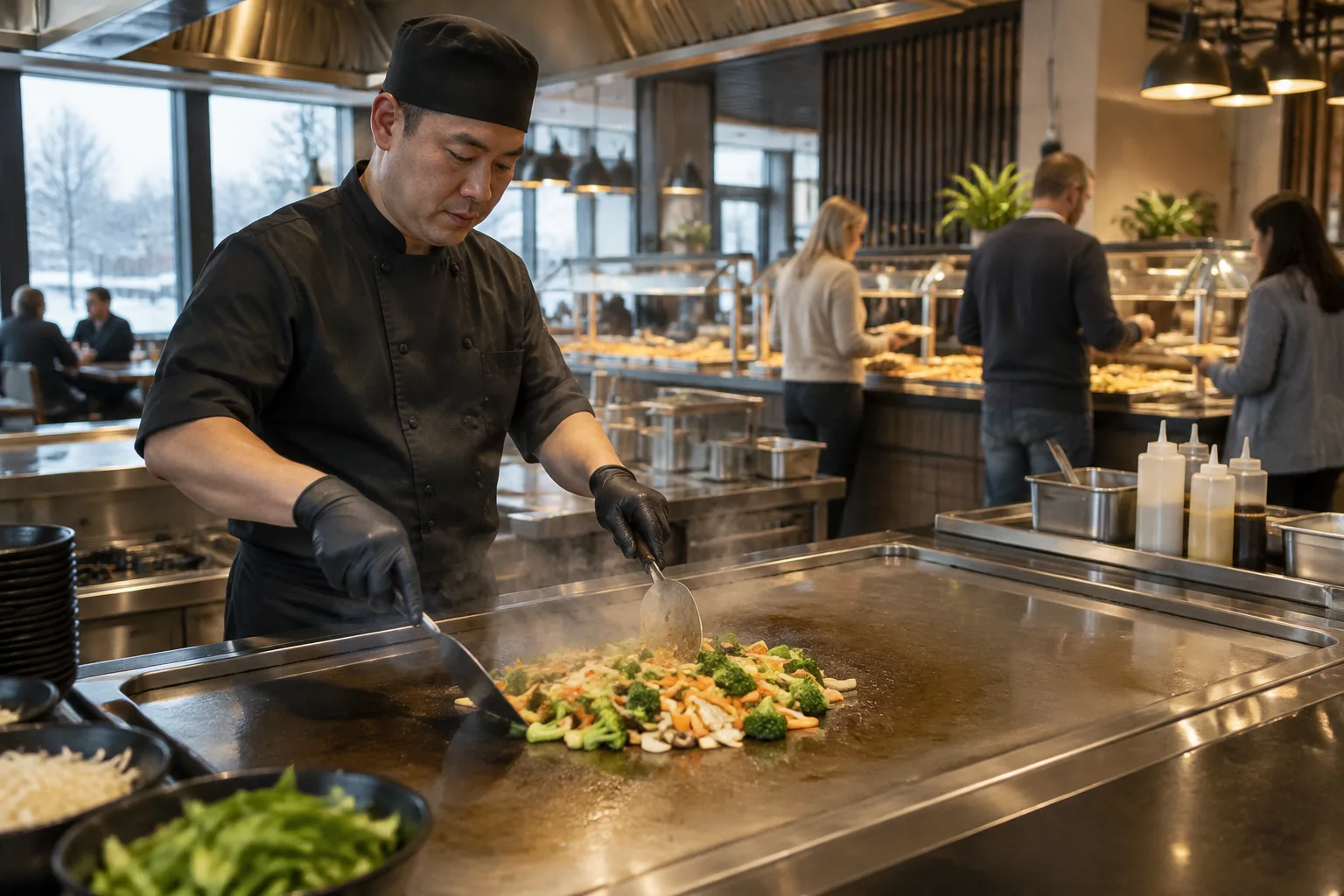
Teppanyaki is a key distinguishing feature of Itsuyaki’s offering. Customers choose ingredients, which a chef cooks in front of them on a hot steel plate. The buffet also offers nearly 100 options, ranging from sushi and salads to deep-fried dishes and desserts.
The interview quotes buffet prices of €15.50 at lunchtime and €20.90 at weekends. The extensive selection and food cooked in front of customers define the concept, while the company also stresses the importance of monitoring each site’s financial performance.
Tang says Itsuyaki is aiming for controlled growth, with three to four new restaurants opening each year. He adds that the company is also monitoring opportunities outside Finland, particularly in the Nordic countries. This refers to exploring opportunities, rather than overseas openings announced in the interview.
This growth strategy completes the picture of a network in which new sites open but underperforming ones may also close. Franchising is one way of organising operations within that network, and existing knowledge of the concept is a priority when selecting franchisees.
Practical takeaway: Prospective franchisees should request site-specific financial figures and clarify what the training covers. A chain-wide efficiency measure alone does not reveal how profitable their own restaurant might be.