Singapore Fast-Food Sales Rise 7.6% in September
Fast-food sales led Singapore’s September F&B recovery, while online transactions accounted for 21.1% of total sales.
Published
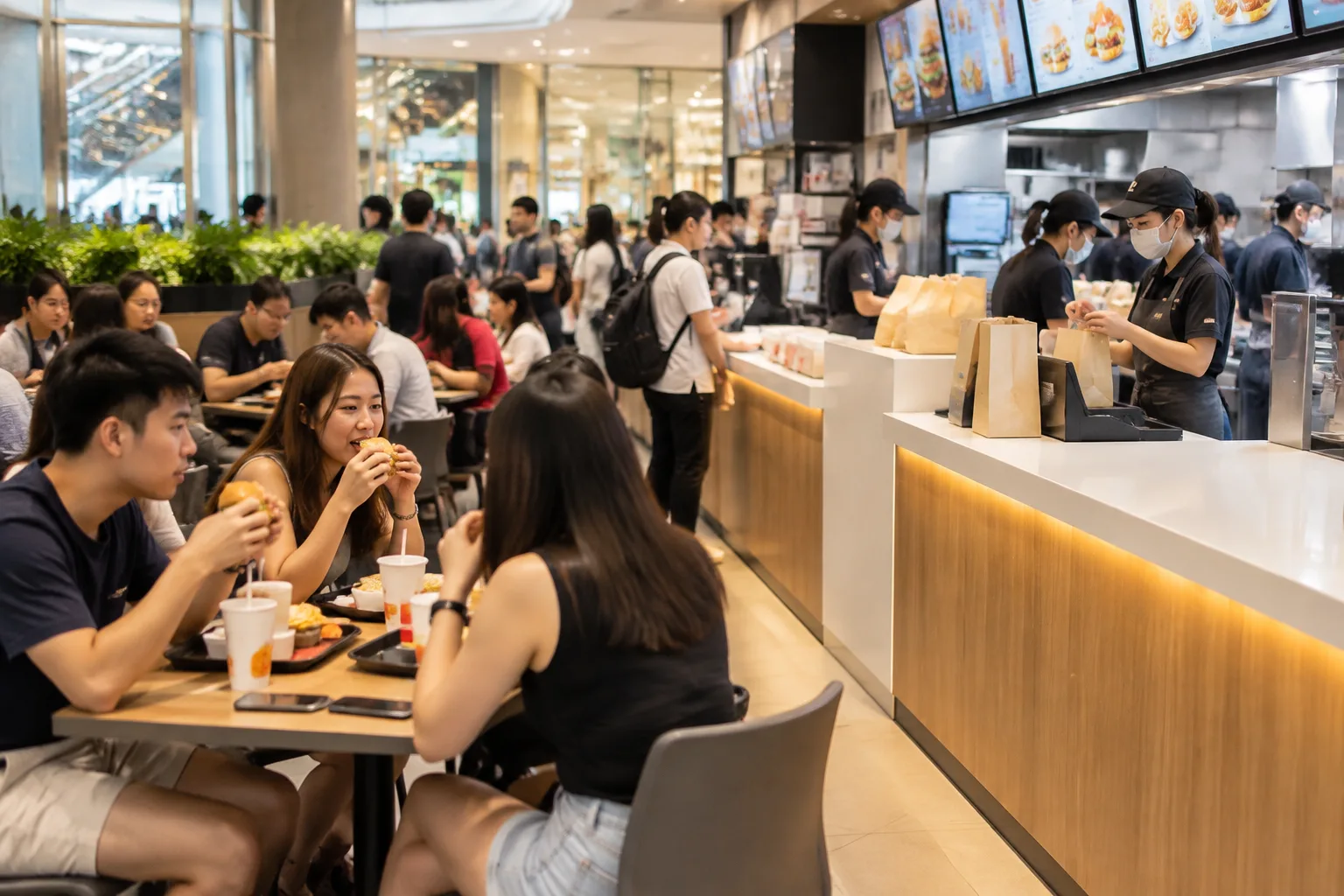
Singapore’s fast-food outlets recorded 7.6% year-on-year sales growth in September 2026, outpacing the wider food and beverage market as overall sales returned to growth. The figures provide Singapore’s franchise community with a useful benchmark, although performance differed sharply between dining formats.
Fast food leads a modest recovery
Food and beverage services sales rose 1% compared with September 2025, reversing the 1.8% year-on-year contraction recorded in August. On a seasonally adjusted basis, September sales increased 0.8% from the previous month.
The Department of Statistics figures, reported by QSR Media Asia on 6 November, put the estimated total value of September F&B sales at S$1.6 billion.
Fast-food outlets delivered the strongest annual performance among the reported categories, with their 7.6% increase well ahead of the overall market’s 1% rise. Restaurants also recorded growth, with turnover increasing 2.6% year on year.
For franchise operators, the headline is therefore not simply that spending recovered. It is that the recovery was uneven, with fast food showing a stronger annual sales trajectory than the broader market.
These are category-level sales figures rather than results for individual chains. They offer context for reviewing a business’s performance, but do not establish whether any particular franchise gained customers, increased its market share or improved profitability.
Dining formats show contrasting results
Outside fast food and restaurants, the annual picture was more subdued. Cafe sales edged up just 0.1%, while food caterers recorded a 0.2% decline.
Food courts and other eating places experienced the largest annual contraction, with sales falling 4.2%. That result contrasts with the gains recorded by both fast-food outlets and restaurants, illustrating why the overall F&B growth figure should not be treated as a uniform measure of trading conditions.
The September year-on-year results were:
- Fast-food outlets: up 7.6%.
- Restaurants: up 2.6%.
- Cafes: up 0.1%.
- Food caterers: down 0.2%.
- Food courts and other eating places: down 4.2%.
The monthly figures also showed differences. On a seasonally adjusted basis, restaurant and fast-food turnover each rose 1.1% from August. Food courts and other eating places were the only reported F&B category to register a monthly decline, falling 2.4%.
Annual and monthly comparisons answer different questions. The former compares September with the same month a year earlier; the latter indicates the change from August after seasonal adjustment. Both showed growth for fast food and restaurants, and contraction for food courts and other eating places.
Online sales account for more than a fifth
Online transactions represented approximately 21.1% of total F&B sales in September, compared with 20.9% in August. That was an increase of 0.2 percentage points in the online share of sales.
The figures place more than one-fifth of recorded F&B spending through online transactions. However, the reported share covers the overall F&B market: it is not a separate measure of online demand for fast-food franchises or any individual brand.
Nor should the change in share be confused with an online sales growth rate. A larger proportion of total spending taking place online is a different measure from the percentage change in the value of online orders.
For operators comparing their own sales channels, the national figure provides a reference point rather than a target. Any assessment of online trading should also consider the business’s own order values, fulfilment costs and contribution to earnings.
What the figures mean for franchise planning
September’s results give Singapore’s franchise community a clearer view of recent trading: modest growth across F&B overall, stronger annual growth in fast food, and continued weakness in food courts and other eating places.
For prospective franchise partners, the distinction between market turnover and individual business performance remains important. Category growth does not, by itself, demonstrate the viability of a proposed outlet or explain the operating results of an existing one.
Likewise, the return to overall annual growth in September follows a contraction in August. These two monthly readings should not be treated as proof of a sustained recovery.
Practical takeaway: Use the September figures to benchmark the relevant dining format, then assess outlet-level sales, costs and online-order economics before making an expansion or franchise investment decision.
Sources
- Gyu-Kaku to Exit Singapore After Final CHIJMES Service
- Chef Behind Xiao Hei Tze Char Name Plans Singapore Departure
- Chipotle Names Jewel for First South-east Asian Restaurant
- Lotteria receives halal certification in Singapore
- Singapore F&B sales rise 1% as fast food leads growth
- Weekly Global Wrap: McDonald's tests new value deal; Wendy's launches online game; Benihana to launch fast-casual sub-brand