German Franchise Association calls for relief in talks with politicians
At the CSU party conference, the German Franchise Association called for less red tape and lower costs. For prospective franchisees, concrete policy decisions remain crucial.
Published
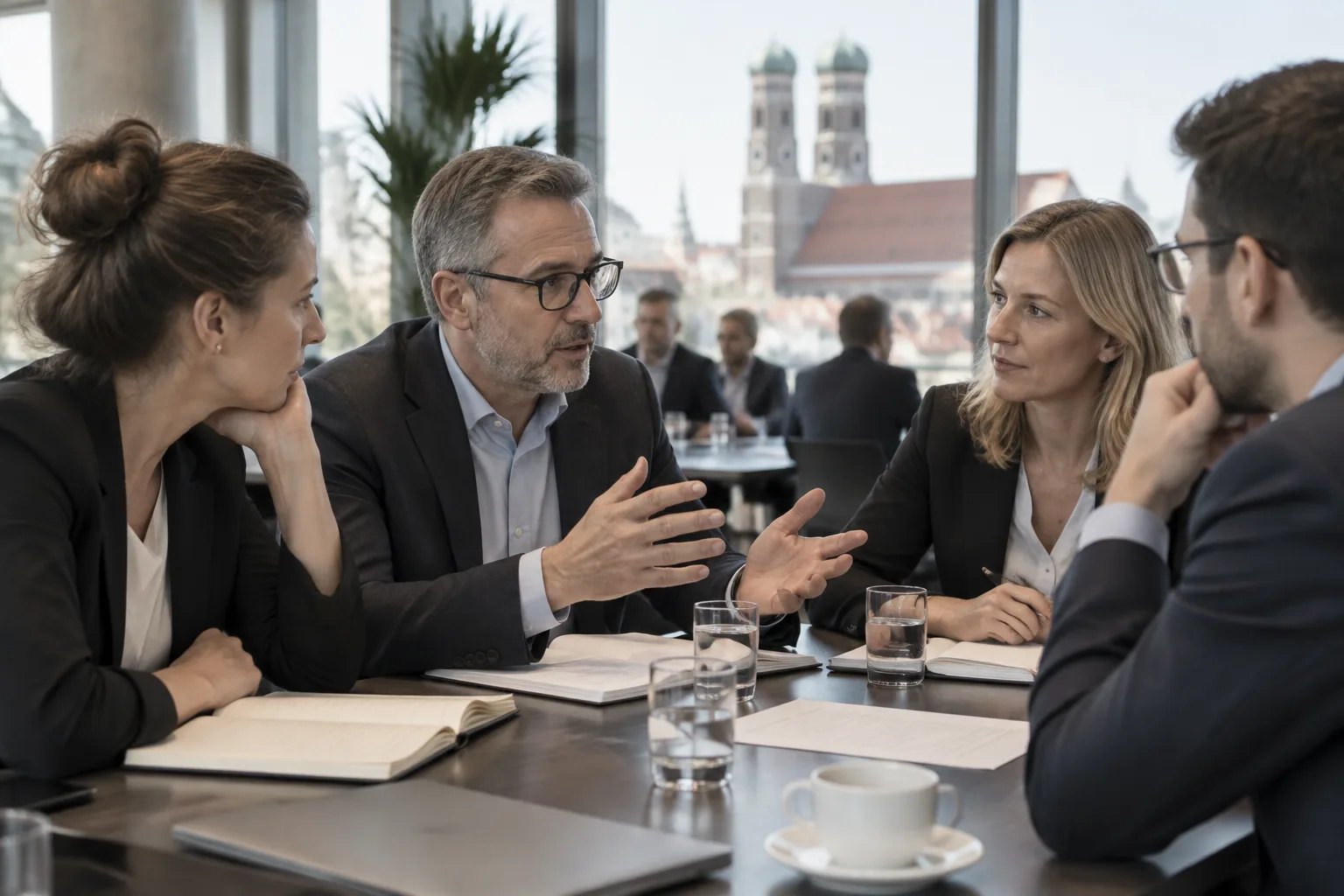
The German Franchise Association called for better conditions for self-employed business owners at the CSU party conference in Munich in October. Its priorities included cutting red tape, reducing energy and non-wage labour costs, and creating a stable environment for investment. For Germany’s franchise sector, the discussions primarily send a political signal: the relief measures requested have not yet been approved.
Association seeks direct dialogue with politicians
According to a report published by the Start Franchising portal on 13 November 2026, the German Franchise Association had its own stand at the conference. Association president Hendrik Martschinke and Vincent Berckenhagen, who is responsible for political advocacy, held talks there with policymakers.
Those they met included Federal Interior Minister Alexander Dobrindt and Martin Huber, Secretary-General of the Christian Social Union (CSU). According to the association, both showed considerable interest in the franchise sector. The event therefore provided an opportunity to raise the concerns of independent franchisees directly with political leaders.
The association intends to continue this dialogue in both Munich and Berlin. Its ambition goes beyond gaining visibility at a party conference: it wants political announcements to lead to concrete decisions. However, the report gives no timetable for implementing the relief measures discussed.
This distinction matters for franchisees. A conversation with political leaders raises awareness of an issue but does not, in itself, change a business’s costs. Nor does interest in the proposals amount to a binding commitment.
Four priorities affecting day-to-day operations
The association’s political agenda has four main priorities: less red tape for new business owners and existing franchisees, lower energy and non-wage labour costs, flexible employment options, and an inheritance tax system that does not jeopardise business transfers.
The focus is therefore not solely on starting a business. The proposals also concern existing operations and the conditions under which a business can eventually be passed on. Business start-ups, employment and succession are considered together in this set of policy demands.
Related issues also featured in speeches at the conference. CSU leader Markus Söder discussed inheritance tax and mini-jobs, Germany’s category of low-earnings employment. Federal Chancellor Friedrich Merz called for a reduction in electricity tax for all, alongside swift reforms to pensions, healthcare and long-term care.
These topics overlap with the association’s concerns. However, this does not establish what future rules will look like or guarantee a financial benefit for individual franchise businesses. Particularly where electricity costs, employment rules and business succession are concerned, much depends on which measures are actually adopted and whom they apply to.
Figures highlight the franchise sector’s economic importance
To put its concerns into context, the association points to turnover of around €149 billion, almost 150,000 independent franchisees and just under 830,000 employees. These figures, cited in the report, illustrate how many livelihoods and jobs are linked to Germany’s franchise sector.
They also explain why the association presents its members’ concerns as issues affecting small and medium-sized businesses. Red tape, energy prices and employment costs affect not only franchisors’ head offices but also the independent franchisees running individual businesses.
Nevertheless, aggregate figures have limited value when assessing an individual start-up opportunity. They describe the sector’s economic importance, not the profitability of a particular location. Anyone considering entering the market should therefore distinguish between political advocacy and the financial assessment of their own proposed business.
In this sense, the association’s political engagement contributes to shaping the wider business environment. It is no substitute for site-specific financial projections or a review of the obligations attached to a franchise agreement.
Prospective franchisees should plan around current conditions
Until specific legislative changes are made, prospective business owners should not treat potential relief as guaranteed savings. The report accordingly recommends using realistic, relatively cautious estimates for energy costs, non-wage labour costs and regulatory requirements in financial plans.
This suggests a practical question to ask a franchisor: are the financial projections based on current conditions, or do they already assume anticipated policy changes? Making this distinction helps separate sound assumptions from possible future improvements.
It is also worth monitoring developments in taxation, mini-job rules and the announced reforms. What matters is not simply political statements of intent, but adopted rules, their scope and when they take effect.
Practical takeaway: The Franchise Association’s proposals address important cost and planning issues. For now, prospective and existing franchisees should base decisions on current rules and factor in potential relief only once binding decisions have been made.