KFC plans new restaurants in four Belarusian cities
New KFC restaurants are planned for Svetlogorsk, Vitebsk, Orsha and Zhlobin. The operator has disclosed expansion incentives and pricing benchmarks.
Published
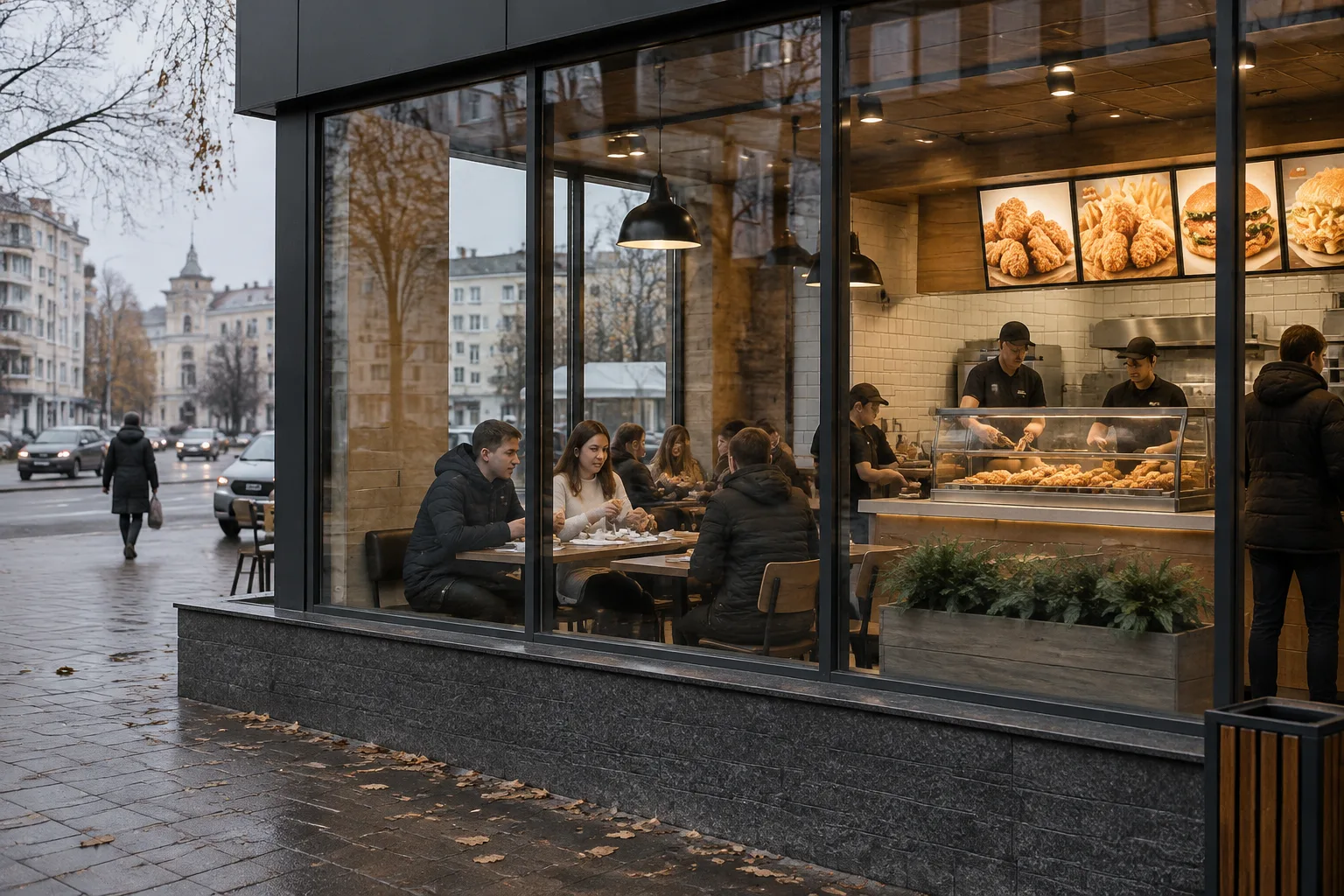
New KFC restaurants are planned for Svetlogorsk, Vitebsk, Orsha and Zhlobin in the coming years. As OfficeLife reported on 4 November 2026, the plans appear in the bond prospectus of CreativeFoodS-Vostok LLC, one of the brand’s two operators in Belarus. For those in the franchise sector, the news is relevant beyond the locations themselves: the document also outlines incentives for new openings and the chain’s competitive benchmarks.
Four cities targeted for expansion
The list of planned openings covers Svetlogorsk, Vitebsk, Orsha and Zhlobin. These are plans for the coming years, not restaurants that have already opened. The report does not give addresses, precise opening dates or the number of restaurants planned for each city. For now, the locations therefore indicate areas for expansion rather than a confirmed opening schedule.
In the prospectus, the operator states that by 2023 the chain already covered all densely populated urban areas in the country. It also says that KFC restaurants operate in almost all Belarusian cities, in locations particularly well suited to the restaurant business. These statements reflect the company’s own assessment and should not be treated as an independent count of the brand’s presence in each city.
According to the report, the new restaurants will add to the existing network. However, the list of cities does not establish that each will be getting its first KFC. For entrepreneurs assessing local competition, it is important to distinguish between the brand entering a new market and adding restaurants where it already operates.
Agreement offers bonuses for additional openings
CreativeFoodS-Vostok and the franchisor, KFC EUROPE S.A.R.L., have a development agreement running until the end of 2026. Under its terms, the Belarusian operator receives bonuses for opening more restaurants than specified in the approved annual plan. The agreement therefore includes a specific incentive to expand beyond the agreed target.
The report does not disclose the size of the bonuses or the annual target itself. The published information is therefore insufficient to assess the financial impact of this mechanism or establish how many additional openings the operator would need to qualify for a bonus. What is confirmed is the principle: the reward is linked to exceeding the plan, rather than simply opening any new restaurant.
It is important to distinguish between two timeframes here. The openings in the four cities are planned for the coming years, while the agreement cited runs only until the end of 2026. The report does not disclose the terms governing the relationship after that date. It would therefore be premature to assume that all future restaurants will fall under the current bonus scheme, or that an extension of the agreement has already been settled.
For the franchise sector, this illustrates why assessing a chain’s development requires more than a list of planned outlets. The agreement’s duration, the agreed pace of expansion and the conditions under which a partner receives additional support all matter. In this case, only some of those details have been made public.
Pricing benchmarked against Mak.by and Burger King
Another stated objective is KFC’s intention to maintain price parity with its main competitors, Mak.by and Burger King. The document links this goal to improving customer loyalty. The operator therefore sees pricing as one element of its customer strategy, alongside expanding its presence.
Price parity should not be interpreted as a promise that every menu item will cost the same as a competitor’s equivalent, or as an announcement of price cuts. The published wording sets a broad competitive benchmark but provides no comparative basket, list of menu items or timetable for price reviews. Specific prices for the future restaurants have not been disclosed either.
For local businesses, the practical significance of this statement lies in the choice of benchmarks. Entrepreneurs operating near potential new outlets would be wise to assess comparable offers and dining formats, rather than infer KFC’s future pricing policy solely from the fact that a restaurant is opening. Expansion alone does not establish that a price war is coming or that average customer spending will change.
Product strategy retains a focus on Belarusian ingredients
According to OfficeLife, KFC’s product strategy remains focused on dishes made with fresh chicken from Belarusian producers. This signals continuity in its approach to its core product as the network expands. Supplier names, purchasing volumes and specific supply arrangements for the new restaurants have not been disclosed.
Taken together, the published plans highlight three priorities for the operator: extending its geographical presence, incentivising openings above the annual target and maintaining competitive pricing. However, they do not include an offer to sell franchises to new partners, restaurant start-up costs or payback projections. It would be wrong to treat this news as an invitation to acquire a KFC outlet.
Practical takeaway: entrepreneurs in the four named cities should factor KFC’s plans into their assessment of local competition, but wait for confirmed addresses and opening dates before making decisions on premises, investment and product ranges. For prospective franchisees, the useful lesson is to check the agreement’s duration and support terms separately from broader promises of network growth.